
A newly soft, spongy or sinking brake pedal needs urgent attention, not an experimental drive to the workshop. If the pedal travels much farther than usual, braking feels weaker, fluid is leaking or a brake warning appears with changed pedal feel, stop using the car and arrange recovery. A pedal that temporarily improves after pumping is not proof that the brakes are safe.
At Edwin Garage, our approach to car servicing and brake assessment in Ang Mo Kio is to separate the symptom from the cause before recommending parts. “Soft pedal” describes a feeling, not a diagnosis. Air, a hydraulic leak, component movement or an internal pressure problem can produce overlapping complaints. The vehicle's braking-system design matters too.
What does a soft brake pedal actually mean?
In a conventional hydraulic system, pedal movement operates a master cylinder, which transmits pressure through brake fluid to the wheel brakes. Fluid should transmit pressure with little compression. Air in the circuit can compress, allowing extra movement before useful braking force builds. A leak or internal seal problem can also prevent the system from maintaining pressure properly.
“Spongy” usually means an unusually springy or compressible feel; “long travel” means the pedal moves farther before the brakes respond; “sinking” means it continues moving under steady pressure. These descriptions help us plan checks, but do not identify a failed component on their own. A hard pedal is a different complaint and can involve reduced assistance rather than the same hydraulic fault.
When should you stop driving?
- The pedal moves close to the floor, needs repeated pumping or no longer gives predictable braking.
- The car takes noticeably longer to slow, pulls sharply while braking or has suddenly changed pedal feel.
- A brake warning accompanies low fluid, visible wetness or reduced braking response.
- The pedal becomes soft after sustained braking, or the symptom starts immediately after brake work.
If already moving, prioritise controlling the vehicle and reaching a safe stopping place without abrupt manoeuvres. Use hazard lights when appropriate. Once stopped safely, do not resume driving to “see whether it happens again”. Arrange roadside assistance or vehicle recovery, and seek emergency assistance if there is immediate danger. A short trip from Hougang to Ang Mo Kio is still a driving risk when braking is uncertain.
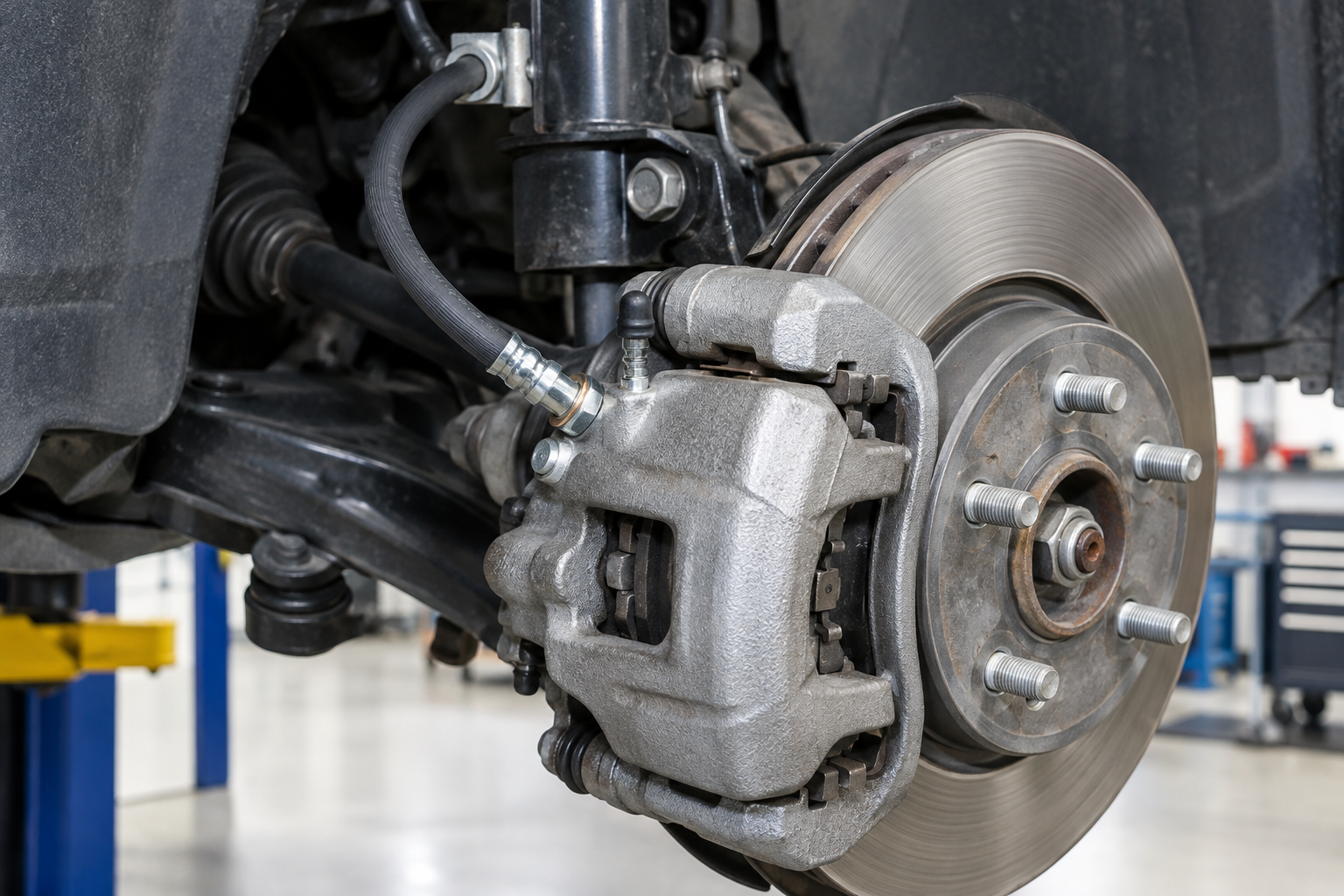
What can cause the change?
Air, leaks and recent hydraulic work
Air can enter when a hydraulic circuit is opened or allowed to run too low. External leakage may occur at pipes, hoses, calipers, wheel cylinders where fitted, or other hydraulic connections. Some leaks are hidden, so a dry patch of ground does not rule them out. After recent work, report exactly what was opened or replaced rather than assuming the repair only needs another quick bleed.
Pressure loss inside a component
Internal master-cylinder seal leakage can cause pressure loss without an obvious puddle. However, pedal movement alone cannot confirm that diagnosis. Other hydraulic units and vehicle-specific operating characteristics must be considered. Replacing the master cylinder on the basis of an internet description risks missing the actual problem.
Excess movement or heat-related changes
Brake adjustment on systems that require it, excessive component clearance, hose deterioration or wheel-end movement may contribute to long travel. Under sufficiently high temperatures, degraded or moisture-contaminated fluid can contribute to vapour formation and reduced hydraulic effectiveness. Singapore traffic does not make every soft pedal a fluid-boiling problem; the operating conditions and physical findings must support that conclusion.
Routine fluid renewal is preventive maintenance, while a changed pedal needs fault assessment. Our brake-fluid maintenance guide explains the separate scheduling question. A fluid change is not a universal cure for leakage, worn seals or mechanical clearance.
What can you record safely before recovery?
From a safely parked position, note when the change began, any warning message and whether work was recently performed. Tell us if it occurred after prolonged braking, only on the first application, or repeatedly. Do not deliberately recreate the symptom on the road or keep pumping the pedal as a home diagnostic test.
If the reservoir is easily visible and the owner's manual identifies it, an external look through the closed reservoir may help describe the level. Do not open unfamiliar caps, add fluid speculatively, crawl under the car or touch hot brakes. Photograph visible wetness only if you can do so without entering traffic or putting yourself underneath the vehicle. “Below minimum” is a reason for investigation, not permission to top up and continue.
How should a workshop investigate it?
- Confirm the exact vehicle and complaint. We need the model, year, braking-system information and repair history, not just a parts guess.
- Assess stationary safety first. Fluid level, warnings, pedal behaviour and visible hydraulic condition guide the next checks. A road test is not the starting point for an unsafe car.
- Inspect the relevant circuit and wheel ends. Look for leakage, hose condition, brake hardware, clearances and associated faults using the correct procedure.
- Use vehicle-specific testing. Fault-code checks, pressure assessment or an electronically controlled bleeding procedure may be needed. A scan alone does not certify hydraulic integrity.
- Agree the repair and verification scope. Rectify the identified fault, bleed or renew fluid where required, then check pedal operation and leaks before any appropriate controlled testing.
Brake friction parts should be assessed on their own evidence. Our guides to brake-pad wear and brake-rotor replacement decisions cover different findings; neither new pads nor new discs automatically fixes a hydraulic pressure fault.
Repair options and what affects the SGD estimate
The correct repair may involve a leaking connection, hose, caliper, wheel cylinder, master cylinder or another confirmed fault. Some vehicles need additional diagnostic equipment or specific bleeding sequences. Hydraulic work should follow the manufacturer's fluid specification and procedure; fluids are not interchangeable simply because their colours look similar.
Ask for an itemised estimate in SGD separating assessment, identified parts, labour, fluid, bleeding and final verification. Clarify whether recovery, further testing, taxes or additional damaged components are included. Availability and access affect the scope. No honest fixed internet price can distinguish a simple connection problem from an electronically controlled hydraulic-unit fault without checking the car.
For an intermittent complaint, record the circumstances and any limits of the investigation. Our guide to preparing for intermittent-fault diagnosis explains useful records. With braking, an unreproduced symptom must not be casually dismissed as proof of safety.
Prevention and two common misconceptions
Follow the vehicle's maintenance schedule, keep service records and report changed pedal feel promptly. Ask what brake work included and whether hydraulic components were opened. For drivers in Yio Chu Kang or Serangoon planning a routine visit, send the history ahead so the appointment concerns are clear. Maintenance planning helps; it does not replace recovery when a fault makes the vehicle unsafe.
“The fluid is full, so the system is fine” is incorrect. Internal leakage or other faults can exist with a normal-looking reservoir. “It firms up when pumped, so I can drive carefully” is also unsafe. Temporary improvement does not establish reliable stopping ability. ABS pulsing during genuine anti-lock intervention is different from persistent softness; our ABS warning-light guide covers that separate warning context.
Arrange the right next step with Edwin Garage
For a newly soft or sinking pedal, tell us the symptoms and arrange recovery rather than driving here. Urgent assistance is subject to availability; a WhatsApp reply cannot certify the car safe. Routine diagnostics, checks and inspections are appointment only, booked exclusively online. WhatsApp is for enquiries, not appointments.
Book a routine assessment online WhatsApp Edwin about this brake-pedal guide
Edwin Garage is at Blk 5032 Ang Mo Kio Industrial Park 2 #01-295, Singapore 569535. Mon–Sat 10am–8pm; closed Sundays. Genuine breakdown, overheating, accident or no-start emergencies may be exceptions to routine appointment arrangements, subject to availability. More maintenance information is available in our Singapore car repair guides.
Can I drive with a soft brake pedal?
Do not drive with newly soft, sinking or unusually long pedal travel, especially with weaker braking, warnings or leakage. Stop using the car and arrange recovery. Temporary improvement does not prove safe braking.
Will topping up brake fluid fix a spongy pedal?
Topping up does not repair a leak, remove trapped air or fix an internal pressure fault. A low level needs investigation. Do not add fluid merely to make a warning disappear and then continue driving.
Does a sinking pedal always mean the master cylinder failed?
No. Internal master-cylinder leakage is one possibility, but other faults and vehicle-specific system behaviour need assessment. A pedal description alone is not enough evidence to authorise that replacement.
Is a soft pedal normal after changing brake pads?
Persistent softness or unusually long travel after brake work should not be dismissed as normal bedding-in. Contact the repairer, stop using the car if braking is uncertain and arrange inspection without driving it there.
Can an ABS scan prove the brakes are safe?
No. A scan may identify electronic faults, but it cannot on its own exclude hydraulic leaks, air or mechanical problems. Safe assessment requires the relevant physical checks and vehicle-specific verification as well.
Key Takeaways
- Do not drive with newly soft, sinking or unusually long pedal travel, especially with weaker braking, warnings or leakage. Stop using the car and arrange recovery. Temporary improvement does not prove safe braking.
- Topping up does not repair a leak, remove trapped air or fix an internal pressure fault. A low level needs investigation. Do not add fluid merely to make a warning disappear and then continue driving.
- No. Internal master-cylinder leakage is one possibility, but other faults and vehicle-specific system behaviour need assessment. A pedal description alone is not enough evidence to authorise that replacement.
- Persistent softness or unusually long travel after brake work should not be dismissed as normal bedding-in. Contact the repairer, stop using the car if braking is uncertain and arrange inspection without driving it there.
Got a Question? Ask Edwin
Edwin Garage is located in Ang Mo Kio. Serving Hougang, Yio Chu Kang, Serangoon & surrounding areas.
WhatsApp Edwin Book Appointment📚 More on Car Servicing & Repair
- Soft Brake Pedal in Singapore: What Should You Do?
- Wheel Bearing Noise in Singapore: Tyres or Bearing?
- Brake Rotor Replacement in Singapore: Do You Need Both Sides Changed?
- Mazda CX-5 Brake Noise: Why It Happens & When to Service
- BMW X3 Brake Service in Singapore: Cost, Interval & What Gets Checked