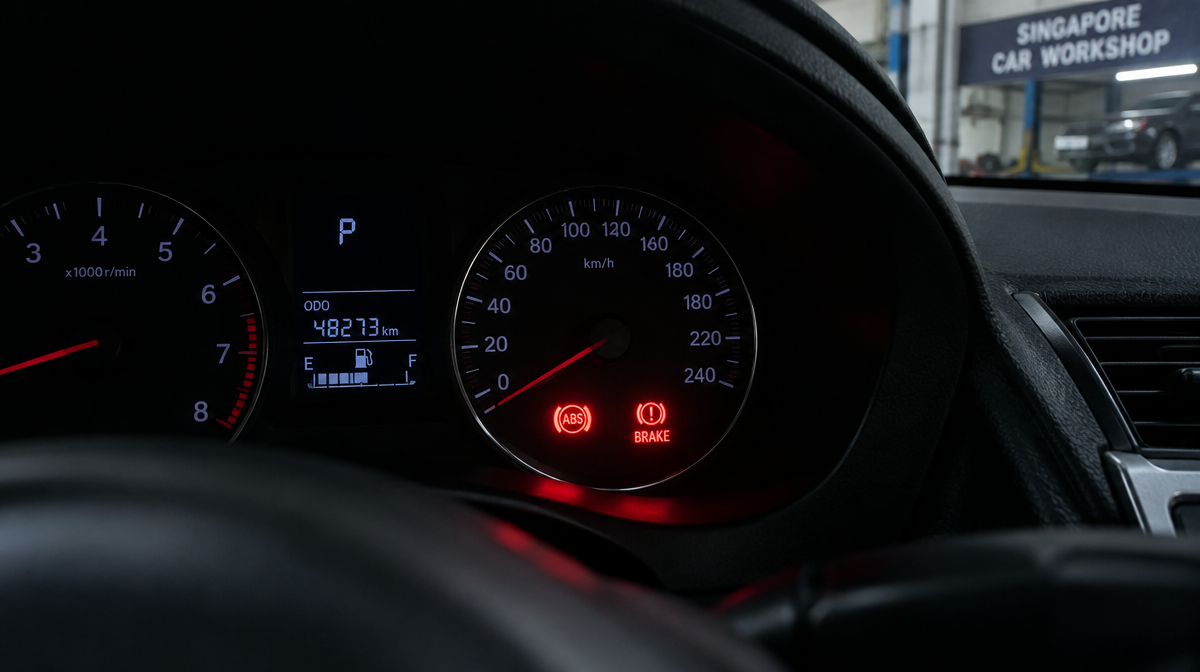
Has your ABS warning light suddenly appeared on your dashboard? Many drivers continue driving because the car still brakes normally. However, an ABS warning light should never be ignored, as it indicates that your Anti-lock Braking System (ABS) may no longer function properly during an emergency.
At Edwin Garage, we regularly diagnose ABS faults for Japanese, Korean and Continental vehicles. The cause of an ABS warning light is not always the ABS pump. Proper diagnosis is essential before replacing any parts.
What Does the ABS System Do?
The Anti-lock Braking System (ABS) is designed to prevent the wheels from locking during sudden or emergency braking.
When you apply maximum braking force, especially on wet or slippery roads, the ABS system rapidly controls the brake pressure within milliseconds. This allows the wheels to continue rotating instead of locking up, helping the driver maintain steering control while reducing the risk of skidding.
Although the system only operates for a split second during emergency braking, it can make a significant difference in helping you avoid an accident.
Common Causes of an ABS Warning Light
An illuminated ABS warning light does not automatically mean the ABS pump has failed. Several components can trigger the warning light, including:
- Faulty wheel speed sensor
- Damaged ABS sensor wiring
- Worn wheel bearing with damaged magnetic encoder ring
- Faulty ABS pump or ABS control module
- Low battery voltage or charging system problems
- Blown fuse or electrical faults
- Internal ABS module failure
Modern vehicles rely on accurate wheel speed signals. On many models, the magnetic encoder ring is integrated into the wheel bearing. When the bearing wears or the encoder becomes damaged, incorrect wheel speed readings can trigger the ABS warning light.
Do You Need to Replace the ABS Pump?
Not necessarily.
Many ABS faults are caused by wheel speed sensors, wheel bearings or wiring issues rather than the ABS pump itself. Replacing an ABS pump without proper diagnosis can result in unnecessary repair costs.
At Edwin Garage, we perform a systematic diagnosis to identify the root cause before recommending any replacement.
ABS Pump Repair vs Replacement
If the ABS pump is confirmed to be faulty, there are generally two repair options.
- ABS Pump Repair: Approximately $950 to $1,200, depending on the vehicle model and fault.
- Brand New ABS Pump Replacement: Approximately $1,600 to $2,000 or more, depending on the manufacturer.
Whenever appropriate, repairing the existing ABS pump may be a more economical alternative than replacing the complete unit.
Can I Continue Driving with an ABS Warning Light?
In many cases, your normal braking system will continue to function, which is why many drivers choose to postpone the repair.
However, without a functioning ABS system, your vehicle may lose its anti-lock braking capability during emergency braking. On wet roads or slippery surfaces, this can increase the risk of wheel lock-up, skidding and loss of steering control.
For your safety, we recommend diagnosing the ABS fault as soon as possible instead of waiting until an emergency situation occurs.
Why Accurate Diagnosis Matters
Replacing parts based on guesswork can become expensive. A proper diagnosis allows us to determine whether the fault lies with the wheel speed sensor, wheel bearing, wiring, ABS pump or another component before recommending repairs.
Our philosophy has always been simple:
Diagnose the fault accurately. Repair only what is necessary.
Frequently Asked Questions
Can I drive with the ABS warning light on?
In many cases, the vehicle can still be driven because the normal braking system continues to operate. However, the Anti-lock Braking System may not function during emergency braking, reducing braking stability on slippery roads.
Does an ABS warning light always mean the ABS pump is faulty?
No. The warning light may be caused by a faulty wheel speed sensor, damaged wheel bearing, wiring problem or another component within the ABS system.
Can an ABS pump be repaired?
Depending on the fault and vehicle model, many ABS pumps can be repaired instead of being replaced with a brand-new unit.
Will a diagnostic scan identify the problem?
A diagnostic scan provides valuable information, but further testing is often required to confirm whether the fault is caused by the sensor, wiring, wheel bearing or ABS pump.
Book an ABS Diagnosis
If your ABS warning light is on, let Edwin Garage diagnose the problem before replacing expensive components unnecessarily.
We will perform a complete diagnostic inspection, explain the findings clearly and recommend the most cost-effective repair solution.
Key Takeaways
- What Does the ABS System Do?
- Common Causes of an ABS Warning Light
- Do You Need to Replace the ABS Pump?
- ABS Pump Repair vs Replacement
Got a Question? Ask Edwin
Edwin Garage is in Ang Mo Kio. We serve Hougang, Yio Chu Kang, Serangoon & surrounding areas.
WhatsApp Edwin Book Appointment