
An intermittent car fault needs a repeatable symptom and a test plan—not a replacement part chosen because the car behaved normally at the workshop. Record when it happens, preserve warning messages and agree how much assessment is authorised. A quiet road test is useful information, but it does not prove the original problem has disappeared.
At Edwin Garage in Ang Mo Kio, our approach to car servicing and fault assessment starts with separating what the driver experienced from what testing can establish. This guide explains how to prepare for a fault that comes and goes, what a workshop can reasonably check, and how to make the next decision without treating uncertainty as a diagnosis.
What makes a car fault intermittent?
An intermittent fault appears only under certain conditions: the first start of the day, after a hot soak, during rain, under acceleration or after a particular journey. The affected system may work normally between episodes. Heat expansion, vibration, changing electrical load or moisture can influence a marginal connection or component, but the timing alone does not identify the cause.
A useful distinction is “not reproduced” versus “no fault exists”. The first describes the limits of a particular assessment. The second is a much stronger conclusion that a short test may not support. Our guide to evidence-led diagnosis explains why symptoms, measurements and repair recommendations should connect.
Record these details before the appointment
- The exact behaviour: does the engine hesitate, the starter fail to turn, a warning appear, or a noise occur?
- Timing: cold start, fully warm, after parking, during acceleration or while stationary.
- Conditions: rain, aircon use, approximate journey duration and whether the engine was restarted.
- Frequency: once in a month, every morning, or increasingly often.
- Recent changes: servicing, battery work, accident repair, accessory installation or a different fuel fill.
- Warning evidence: the exact message, symbol, colour and any safely captured photograph.
Be specific without guessing. “The engine turns but does not fire after a short stop” is more informative than “battery problem”. A driver travelling from Hougang to Ang Mo Kio can describe the normal journey conditions without deliberately repeating an unsafe incident. If starting is the concern, our battery, alternator and starter comparison shows why different starting behaviours lead to different checks.
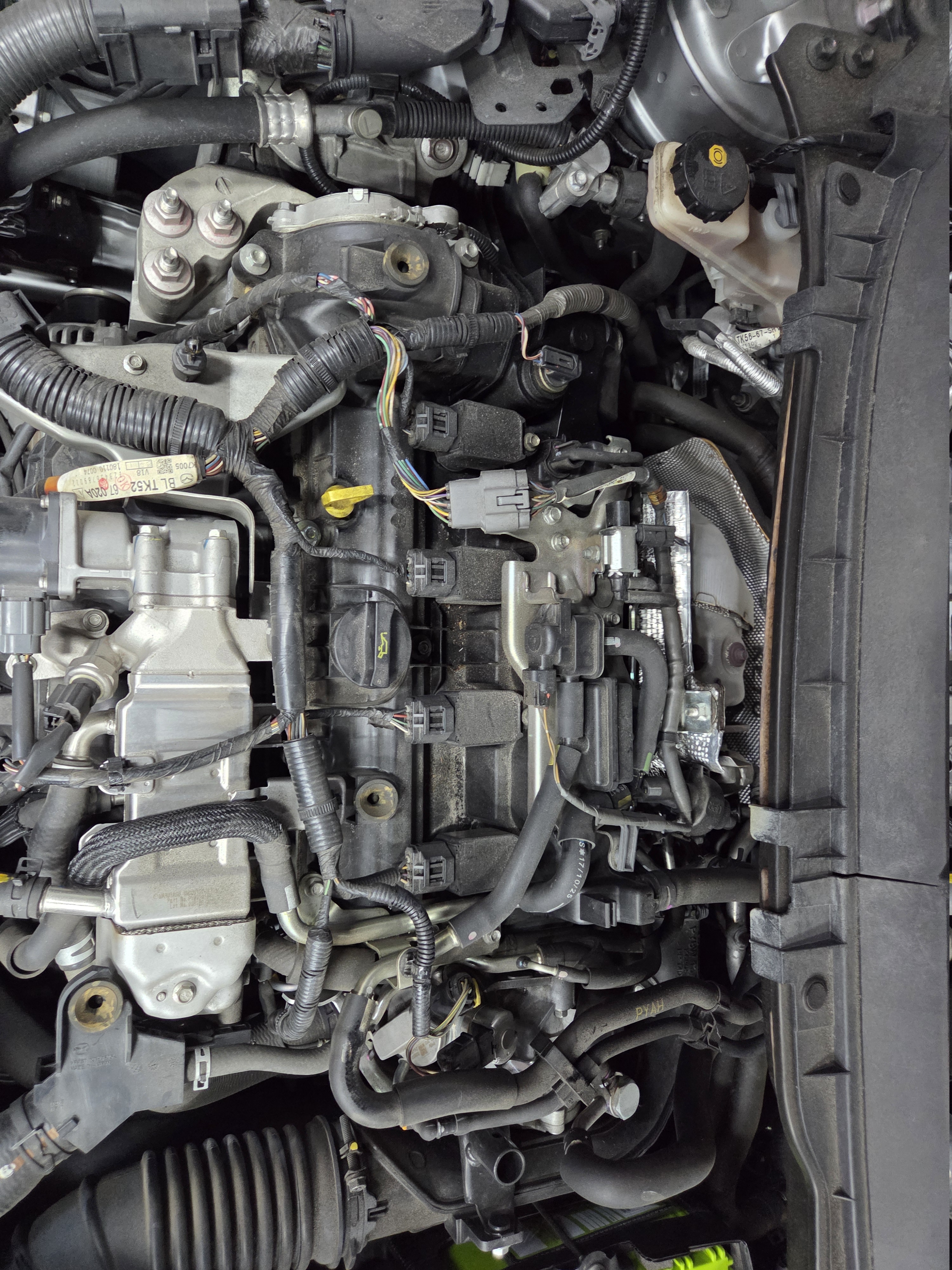
Authentic Edwin Garage workshop photograph showing an engine bay with ignition components, connectors and wiring. These are examples of areas an assessment may involve; the photograph does not establish an intermittent fault or a completed diagnosis.
Capture evidence safely, not while driving
Never use a handheld phone, open the bonnet in an unsafe place or provoke the symptom in traffic. A passenger may record a noise when safe, or you can describe it after parking. A short recording should include context: whether the vehicle was moving, braking, turning or idling. An isolated sound rarely proves which component failed.
Keep original photos and recordings rather than only a compressed forwarded copy. Note the date and approximate time. Do not publish number plates, vehicle documents or identifiable passengers unnecessarily. You do not need a professional video: a clear description and a dashboard photograph taken safely can be more useful than several minutes of road footage.
Which causes should the workshop consider?
There is no reliable universal ranking for every intermittent complaint. Checks should follow the affected system and evidence. Possible categories include loose or damaged connections, poor grounds, unstable power supply, sensors whose output changes with temperature, ignition or fuel-delivery problems, and mechanical issues that appear only under load. Software information may matter on some vehicles, but an update is not automatically the answer.
For rough running, a workshop may distinguish combustion irregularity from vibration transmitted through a mount. Our engine-mount versus misfire guide covers that distinction. Singapore heat, humidity and stop-start traffic are useful context—not proof that a particular part has worn out. The vehicle specification, history and actual measurements still matter.
What an agreed diagnostic plan can include
- Clarify the complaint. Confirm what happened and whether the vehicle can safely be operated.
- Review records. Read previous estimates, repair invoices and relevant maintenance history.
- Preserve diagnostic information. Where applicable, inspect stored, pending and history codes, freeze-frame information and module communication before clearing anything.
- Inspect and measure. Target wiring, supply voltage, connectors, live data or mechanical checks according to the symptom.
- Reproduce safely. Agree whether a cold-start observation, hot restart or controlled road test is appropriate.
- Explain the result. Separate confirmed findings, plausible leads and checks that remain incomplete.
A fault code is a starting point, not necessarily a parts order. Conversely, no stored code does not exclude a mechanical problem or a brief electrical interruption. Some information disappears after resets or battery disconnection. Avoid clearing codes simply to make the dashboard look normal before an appointment; tell the workshop if information has already been erased.
If the symptom does not appear during testing
Ask for a written summary of the conditions tested and the findings. “Could not reproduce after a warm road test” is different from “cold-start operation checked”. Agree what additional evidence would change the recommendation and whether another visit, longer observation or specialist assessment is justified. Do not assume every workshop has every logging instrument or vehicle-specific capability.
At our Ang Mo Kio workshop, we encourage a clear discussion about the next authorised stage rather than an open-ended instruction to replace likely parts. Our repair-authorisation guide explains assessment limits and extra-work approval. If you seek another opinion, bring the first findings so the next workshop can understand what has already been tested.
Repair options, cost factors and verification
The appropriate repair might be a verified connector repair, wiring work, replacement of a tested component, a mechanical repair or model-specific software action. Parts should match the vehicle specification. If several faults are possible, discuss the evidence and residual uncertainty before authorising a staged repair. Replacing several components together can hide which finding actually resolved the complaint.
Request an itemised estimate in Singapore dollars covering the initial assessment, any extended observation, dismantling, parts, consumables and verification. Clarify whether overnight retention is needed and whether recovery or external specialist work is separate. There is no supported generic price range for every intermittent fault; a short electrical check and a prolonged temperature-dependent investigation are different scopes.
After repair, verification should address the original conditions where safely possible. A normal idle alone cannot confirm that a fault occurring only on a hot restart is resolved. Discuss what was tested, what remains untested and what to do if symptoms return. Our repair-handover checklist helps you collect these details without treating a test result as an unlimited assurance.
Prevention and common misconceptions
Maintain the vehicle to its model-specific schedule, keep service records and report warning signs before they escalate. Avoid improvised wiring, unspecified fluids and repeatedly fitting parts based only on online anecdotes. If the fault followed recent work, provide the timeline without assuming that work caused it. Correlation helps investigation but is not a finding of responsibility.
“It restarted, so it is safe” is not a reliable rule. A temporary recovery does not establish the condition of brakes, steering or engine lubrication. “A scan will name the broken part” is also misleading. Codes and live data require interpretation alongside physical testing. Ask what evidence supports the proposed work rather than demanding either certainty without testing or immediate replacement.
When to stop rather than wait for recurrence
- Loss of braking effectiveness or steering control, or a vehicle that stalls in traffic.
- Overheating, steam, a significant fluid leak or an oil-pressure warning.
- Smoke, a burning smell, visible electrical damage or a fuel smell.
- A flashing engine warning with severe shaking or substantial loss of power.
Move out of traffic only as safely possible, stop and arrange appropriate assistance. Do not drive repeatedly to “collect evidence”. Use the vehicle manual for warning-specific instructions. Our Singapore car repair guides provide further context, but an article cannot assess your vehicle remotely.
Book an assessment with useful information
For drivers in Yio Chu Kang, Serangoon and the surrounding area, preparation can make the first discussion more productive. Bring the symptom notes, warning photographs and previous repair records. Tell us if the car may need to arrive cold or cannot safely be driven; any observation or retention arrangement must be agreed, not assumed.
Routine diagnostics, checks and inspections are appointment only. Book your appointment online. For enquiries—not bookings—WhatsApp Edwin about this intermittent-fault guide. Genuine breakdown, overheating, accident and no-start emergencies may be exceptions subject to availability. Edwin Garage is at Blk 5032 Ang Mo Kio Industrial Park 2 #01-295, open Monday–Saturday, 10am–8pm; closed Sundays.
Can a workshop diagnose a fault that is not happening now?
Sometimes. Stored information, inspection and targeted measurements may identify a cause, but some faults require observation under the original conditions. Ask which findings are confirmed and which remain uncertain.
Should I clear fault codes before my appointment?
Generally, preserve them for assessment rather than clearing them to remove a warning. A reset may erase useful diagnostic context. Tell the workshop about any previous reset or battery disconnection.
Should I keep driving until the fault becomes permanent?
No. Intermittent safety-related symptoms need prompt assessment. If braking, steering, overheating, lubrication or safe vehicle operation is affected, stop safely and arrange assistance instead of waiting for another episode.
Will replacing the part named in a fault code fix it?
Not necessarily. A code may reflect a circuit, supply, connection or operating-condition problem rather than failure of the named component. Repair approval should follow relevant testing, not the code description alone.
What should I bring for an intermittent-fault appointment?
Bring symptom notes, safely captured warning photos or recordings, service history and previous findings. Include cold or warm conditions, journey duration, frequency and recent work so the assessment can target the original complaint.
Key Takeaways
- Sometimes. Stored information, inspection and targeted measurements may identify a cause, but some faults require observation under the original conditions. Ask which findings are confirmed and which remain uncertain.
- Generally, preserve them for assessment rather than clearing them to remove a warning. A reset may erase useful diagnostic context. Tell the workshop about any previous reset or battery disconnection.
- No. Intermittent safety-related symptoms need prompt assessment. If braking, steering, overheating, lubrication or safe vehicle operation is affected, stop safely and arrange assistance instead of waiting for another episode.
- Not necessarily. A code may reflect a circuit, supply, connection or operating-condition problem rather than failure of the named component. Repair approval should follow relevant testing, not the code description alone.
Got a Question? Ask Edwin
Edwin Garage is located in Ang Mo Kio. Serving Hougang, Yio Chu Kang, Serangoon & surrounding areas.
WhatsApp Edwin Book Appointment📚 More on Car Servicing & Repair
- Intermittent Car Faults in Singapore: Prepare for Diagnosis
- Car Repair Handover Checklist in Singapore: Before You Leave
- Car Repair Authorisation in Singapore: Set Limits Before Work
- Car Repair Second Opinion in Singapore: Compare Evidence & Scope
- How Edwin Garage Diagnoses Car Problems Without Guessing in Singapore