
A car repair warranty is only useful when you know what it covers, who handles a return and what happens if the symptom comes back. Before approving work in Singapore, ask for the applicable parts and workmanship terms in writing, including any time or mileage limit, exclusions and assessment procedure. Do not assume every component on the invoice has identical cover.
At Edwin Garage, we want drivers using our car servicing and repair workshop in Ang Mo Kio to ask these questions before making a decision. This guide explains how to compare warranty scope; it does not announce a universal Edwin Garage warranty or replace the written terms for your particular repair. Clear expectations matter more than a reassuring slogan.
What does a car repair warranty actually cover?
Parts cover and workmanship cover are different. A replacement component may have supplier-backed terms, while installation work may be dealt with separately by the workshop. A supplier might accept a defective part but not automatically pay removal, refitting, fluids, transport or diagnostic labour. Ask who pays each item if a covered failure is confirmed.
Time and mileage conditions also need careful reading. If the terms specify both, ask whether cover ends when either limit is reached. Confirm when the period begins, which vehicle and part it applies to, and whether a replacement supplied during a claim changes that period. There is no single answer that can safely be assumed for every repair.
A repair warranty is not a promise that the entire car will remain fault-free. Replacing an alternator, for example, does not automatically cover an old battery, damaged wiring or a separate starter fault. The repair description should identify the diagnosed issue and the work authorised to address it.
Warning signs in unclear warranty wording
- “Warranty included” without saying whether this means the part, labour or both.
- No clear component specification, invoice reference or start date.
- A long advertised period with no explanation of exclusions or claim steps.
- An assumption that any returning warning light must be a free repair.
- No agreement about inspection, dismantling or transport charges during a return.
These gaps do not prove dishonesty, but they are a reason to pause and clarify. If you are comparing quotations from Hougang or Serangoon, compare the same repair scope first. A cheaper component-only offer is not directly equivalent to an offer that includes installation labour under stated conditions. Our car repair second-opinion guide explains how to compare evidence rather than just totals.
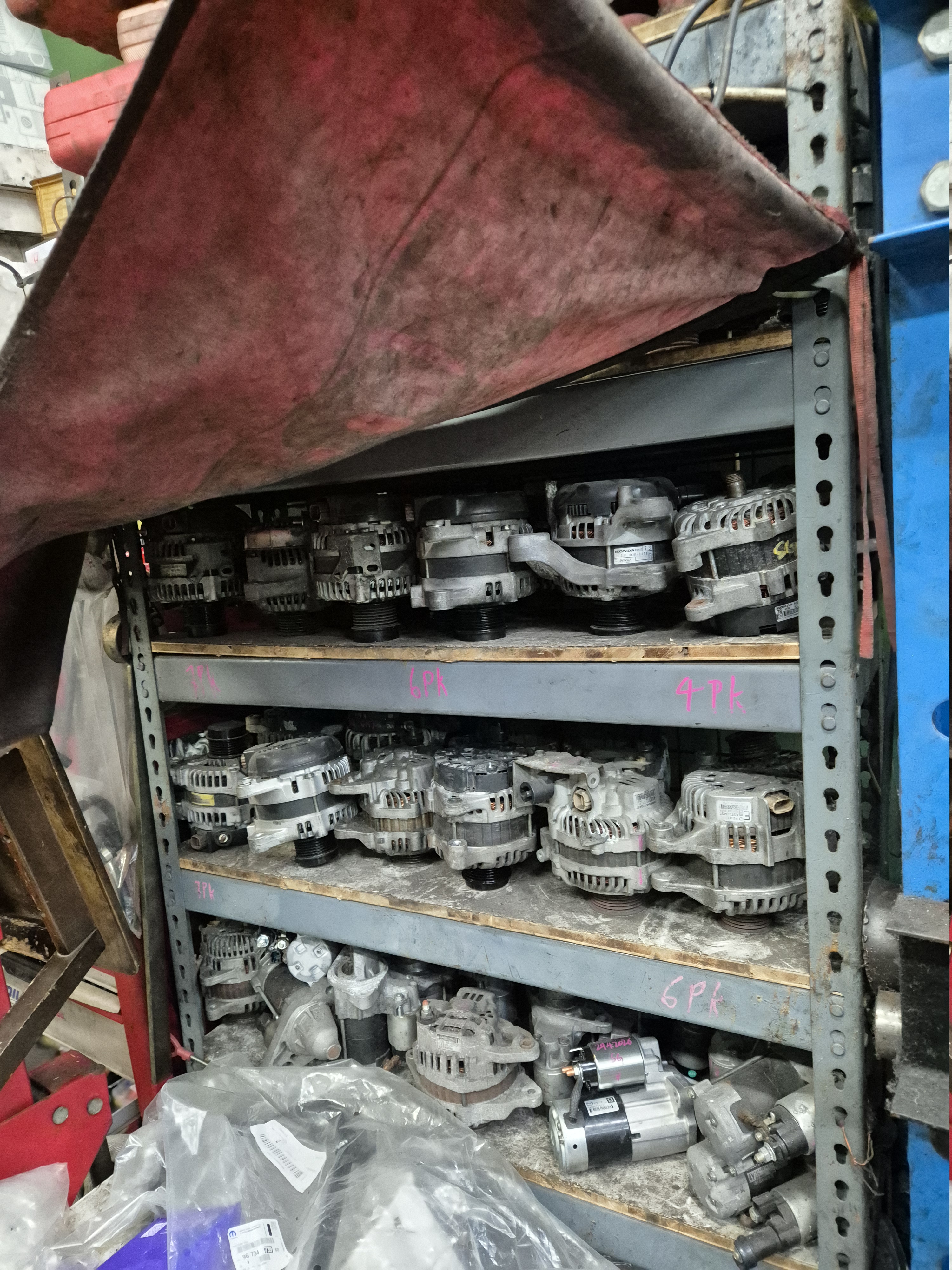
Authentic workshop photo from our photo pool showing stored alternators and starter components. It illustrates why the exact part specification matters; it is not evidence of a warranty claim, tested condition or coverage for any pictured unit.
Why can the same symptom return after a repair?
A returning symptom needs assessment, not an instant verdict. Possible explanations include an installation issue, a replacement part fault, an unresolved contributing condition or a separate fault that feels similar. We cannot rank these possibilities for your vehicle without evidence. A dashboard warning is a starting point, not proof that a particular part has failed again.
For example, an electrical warning after alternator replacement could involve the charging unit, a connection, belt drive or battery condition. This is a general explanation, not a customer case. A component can also be damaged by another system fault. In Singapore's heat and stop-start driving, note when the symptom appears, but do not treat the weather as a diagnosis or an automatic reason to refuse cover.
If the concern comes and goes, record dates, conditions and warning messages without distracting yourself while driving. Avoid clearing fault codes or repeatedly disconnecting the battery just to hide the symptom. The preparation steps in our intermittent-fault diagnosis guide can help preserve useful information.
Seven questions to ask before approving the job
- What is being repaired? Ask for the fault finding and the exact parts and operations proposed.
- What type of part is supplied? Identify new, remanufactured or used, with the relevant specification and supplier where available.
- What covers the part and the installation? Separate the two rather than accepting a vague combined description.
- What are the limits? Confirm dates, mileage conditions, usage restrictions and maintenance requirements.
- What is excluded? Ask about wear, unrelated faults, external damage and any stated conditions.
- How is a return assessed? Confirm who receives the vehicle and whether supplier inspection is needed.
- What could I have to pay? Clarify testing, dismantling, refitting and transport before giving approval.
For component choices, our comparison of remanufactured and second-hand car parts gives useful background. Do not assume that “new” always means identical terms, or that every remanufactured unit has the same testing and warranty arrangements. Ask about the actual product being quoted.
How to handle a possible warranty return
First, check safety. If braking is affected, the engine overheats, there is a strong fuel smell, or smoke appears, stop safely and arrange appropriate assistance rather than driving back to prove the fault. Do not keep running a vehicle to collect a better video. A warranty discussion must never take priority over immediate safety.
For a non-emergency concern, contact the original repairer with the invoice, current mileage, symptom and when it started. Ask how to arrange assessment under the applicable terms. At Edwin Garage, routine checks, inspections and diagnostics are appointment only, booked exclusively online. WhatsApp is for enquiries, not booking. Genuine breakdown, overheating, accident and no-start emergencies are subject to availability.
At assessment, the workshop may need to reproduce the concern, inspect the installation and test relevant systems. A supplier may require a removed component for examination. Ask what can be established before dismantling, whether any work needs separate approval and when you can expect an update. Our repair-authorisation guide explains how to set spending and dismantling limits.
Costs: separate covered work from chargeable investigation
Request an itemised estimate in SGD instead of assuming a return visit is either entirely free or fully chargeable. The assessment scope, access required, supplier decision, part type and cause of failure can affect the outcome. Clarify whether an assessment charge applies, whether it is waived if cover is accepted, and whether GST is included or applicable.
Ask what happens if testing finds an unrelated problem. No additional repair should be treated as approved merely because the vehicle is already dismantled. Our diagnostic-fee guide helps distinguish investigation from component replacement. We do not publish an invented universal warranty price or promise free labour for every return.
Records and habits that make follow-up easier
Keep the quotation, invoice, written terms, mileage and any handover notes together. Retain service records relevant to the repaired system and follow agreed maintenance instructions. If someone else works on the car later, record what was done and tell the assessing workshop; do not assume that all cover is automatically cancelled, or automatically unaffected.
Read the handover explanation before leaving. Check which concern was resolved, any outstanding issue and any follow-up requested. Drivers travelling from Yio Chu Kang should not have to reconstruct the conversation weeks later. Clear records also help a workshop distinguish a previously reported symptom from a new one without arguing from memory.
Misconceptions worth clearing up
“The longest warranty is always the best deal.” Not necessarily: coverage, exclusions, assessment access and who pays labour matter too. “The same symptom means the same failed part.” Not always: several systems can produce similar behaviour. Evidence should decide the repair and coverage discussion.
“Written warranty terms settle every possible dispute.” They clarify the agreement, but contractual cover and any applicable consumer rights are not necessarily the same thing. This article is practical workshop guidance, not legal advice. If a disagreement persists, request the reasons and supporting findings in writing and seek appropriate consumer or legal guidance.
Book an assessment with the paperwork ready
At Edwin Garage, we would rather clarify the concern and scope than let you assume a promise nobody has defined. Bring the previous invoice and describe what has changed. Our Ang Mo Kio workshop is at Blk 5032 Industrial Park 2 #01-295, Singapore 569535, open Monday–Saturday, 10am–8pm, closed Sundays.
Book your appointment online for routine assessment. For questions before booking, WhatsApp Edwin on 97856612 for enquiries. Browse our Singapore car repair guides for related decisions. An enquiry is not a confirmed appointment.
Does every car repair in Singapore have the same warranty?
No. Parts, labour, limits and exclusions vary with the repair and written agreement. Confirm the terms for the exact job rather than assuming a universal period or whole-car cover.
Is diagnostic labour automatically free on a warranty return?
No. Ask whether assessment is chargeable, when a charge might be waived and what approval is needed before testing or dismantling. The applicable terms and findings determine the next step.
Does the same warning light prove the repaired part failed?
No. Similar warnings can have different causes. Inspection and relevant testing are needed to distinguish a part fault, installation issue, contributing condition or unrelated problem.
What should I keep after a car repair?
Keep the invoice, quotation, written warranty terms, mileage and handover notes, plus relevant service records. Save symptom dates and warning messages safely if the concern returns.
Can I drive back if a possible warranty fault returns?
Only if the vehicle is safe to drive; warranty cover is not a safety clearance. Stop safely for serious braking problems, overheating, fuel smell or smoke and arrange appropriate assistance. Routine assessments require an online appointment.
Key Takeaways
- No. Parts, labour, limits and exclusions vary with the repair and written agreement. Confirm the terms for the exact job rather than assuming a universal period or whole-car cover.
- No. Ask whether assessment is chargeable, when a charge might be waived and what approval is needed before testing or dismantling. The applicable terms and findings determine the next step.
- No. Similar warnings can have different causes. Inspection and relevant testing are needed to distinguish a part fault, installation issue, contributing condition or unrelated problem.
- Keep the invoice, quotation, written warranty terms, mileage and handover notes, plus relevant service records. Save symptom dates and warning messages safely if the concern returns.
Got a Question? Ask Edwin
Edwin Garage is located in Ang Mo Kio. Serving Hougang, Yio Chu Kang, Serangoon & surrounding areas.
WhatsApp Edwin Book Appointment📚 More on Car Servicing & Repair
- Car Repair Warranty in Singapore: What to Ask
- Car Diagnostic Fee in Singapore: What Does It Cover?
- Car Repair Handover Checklist in Singapore: Before You Leave
- Car Repair Authorisation in Singapore: Set Limits Before Work
- Car Repair Second Opinion in Singapore: Compare Evidence & Scope