If the same car problem returns after a repair, first decide whether it is safe to stop or move the vehicle, then contact the repairing workshop with the invoice, timeline and exact symptoms. Do not clear fault codes, buy another part or assume that the original repair has failed. A familiar noise, warning or loss of cooling can have more than one cause. The useful next step is a documented reassessment, not a second round of guesses.
At Edwin Garage, our approach to car servicing and repair in Ang Mo Kio starts with separating what was confirmed from what still needs testing. For a driver travelling from Hougang or Serangoon, that distinction can save an unnecessary trip and clarify whether recovery is needed. This guide explains how to prepare for a return visit without assuming blame or promising that every recurrence is covered.
First: when should you stop driving?
A recent repair is not driving-safety clearance. Stop as soon as it is safe if there is overheating, an oil-pressure warning while running, unreliable braking or steering, severe vibration, loss of drive, smoke, a strong fuel smell or a flashing engine warning with rough running. Secure the vehicle and arrange recovery rather than trying to reach the workshop. Follow the vehicle handbook’s exact warning instructions; a steady amber light alone cannot establish that driving is safe.
For fire or immediate danger, leave the vehicle away from traffic and contact the emergency services. Do not open a hot cooling-system cap, investigate orange high-voltage cables or repeatedly restart a car to see whether a serious warning disappears. The AA’s engine-management-light guidance also distinguishes a warning light from a specific diagnosis and highlights the urgency of flashing warnings or accompanying symptoms. Use your own vehicle’s instructions, not a generic distance allowance.
Does the same symptom mean the same fault?
No. A symptom describes what you experience; a diagnosis identifies the supported cause. “Aircon warm again” might involve a leak elsewhere, an electrical control problem or the repaired component. “Engine shaking again” might involve ignition, fuelling, wiring or a separate mechanical concern. These are possibilities to test, not a ranking of what failed on your car.
Likewise, the same diagnostic trouble code may have several underlying causes, while a different code may relate to the same wider system. A code naming a sensor does not prove that the sensor needs replacement. Compare the original test results and repair scope with fresh evidence. Our guide to preparing for intermittent-fault diagnosis explains why the conditions under which a fault occurs matter.
Why can a problem come back after work?
- The original cause remains unresolved. A reset or temporary improvement may have hidden rather than corrected it. Ask what test established the original diagnosis.
- The repair had a limited agreed scope. Replacing one leaking component does not establish that every other seal, hose or connection is sound.
- A related issue was intermittent. Heat, load or moisture may expose an electrical connection or mechanical problem that was absent during the first inspection.
- A fitted part or installation needs review. Compatibility, connections, adjustment, workmanship and component condition may need checking; none should be assumed from timing alone.
- A separate fault produces a similar feeling. An unrelated problem can occur after a repair, but “coincidence” also needs supporting evidence rather than dismissal.
Singapore’s short trips, aircon demand and stop-start traffic can make operating conditions important. A complaint after a hot restart near Yio Chu Kang is different from one after an overnight park. Record the difference without deliberately recreating a dangerous situation.
What to record before contacting the workshop
- The original paperwork: invoice number, repair date, odometer reading, complaint description and items authorised.
- The recurrence: date, approximate mileage since collection, whether the symptom fully disappeared and how long it stayed away.
- The conditions: cold or warm engine, parked or moving, weather, aircon setting and whether acceleration, braking or turning was involved.
- The exact warning: wording, colour, steady or flashing, and whether it appeared with the engine running. Photograph only while safely parked or have a passenger document it without distracting the driver.
- Anything that changed: refuelling, a flat battery, other work, an impact, accessories or fluid added. Report it honestly; it may help diagnosis.
Keep information factual: “The vibration returned after 40 minutes in traffic” is more useful than “the new mount is defective.” Do not touch leaking fluids, crawl underneath or film while driving. If a fault-code report already exists, save the full report, not just a screenshot of one code.
Do not erase the evidence to make the warning go away
A battery disconnection or scan-tool reset can remove useful information on some vehicles, including stored codes and operating snapshots. It may also reset readiness checks or learned settings. Do not do this merely to hide a returning warning. Clearing a light does not repair the underlying cause, and a light staying off briefly does not confirm a cure.
A technician may clear codes as part of a documented diagnostic or verification procedure after recording the relevant information. That differs from repeated blind resets. Tell the workshop if anyone has already erased codes or changed parts; useful assessment is still possible, but the missing history matters.

Authentic Edwin Garage engine-bay photograph, used to illustrate the multiple systems involved in a running complaint. It is not evidence of a repeat failure, a particular diagnosis or a documented return visit.
What a useful reassessment should establish
Start with the original complaint and agreed work. Ask which tests supported that repair, what was checked after completion and what was outside scope. A useful next step could include a visual inspection, vehicle-specific scan, electrical measurement, pressure test or examination of the previously disturbed area. The method should follow the symptom and vehicle, not a fixed shopping list of parts.
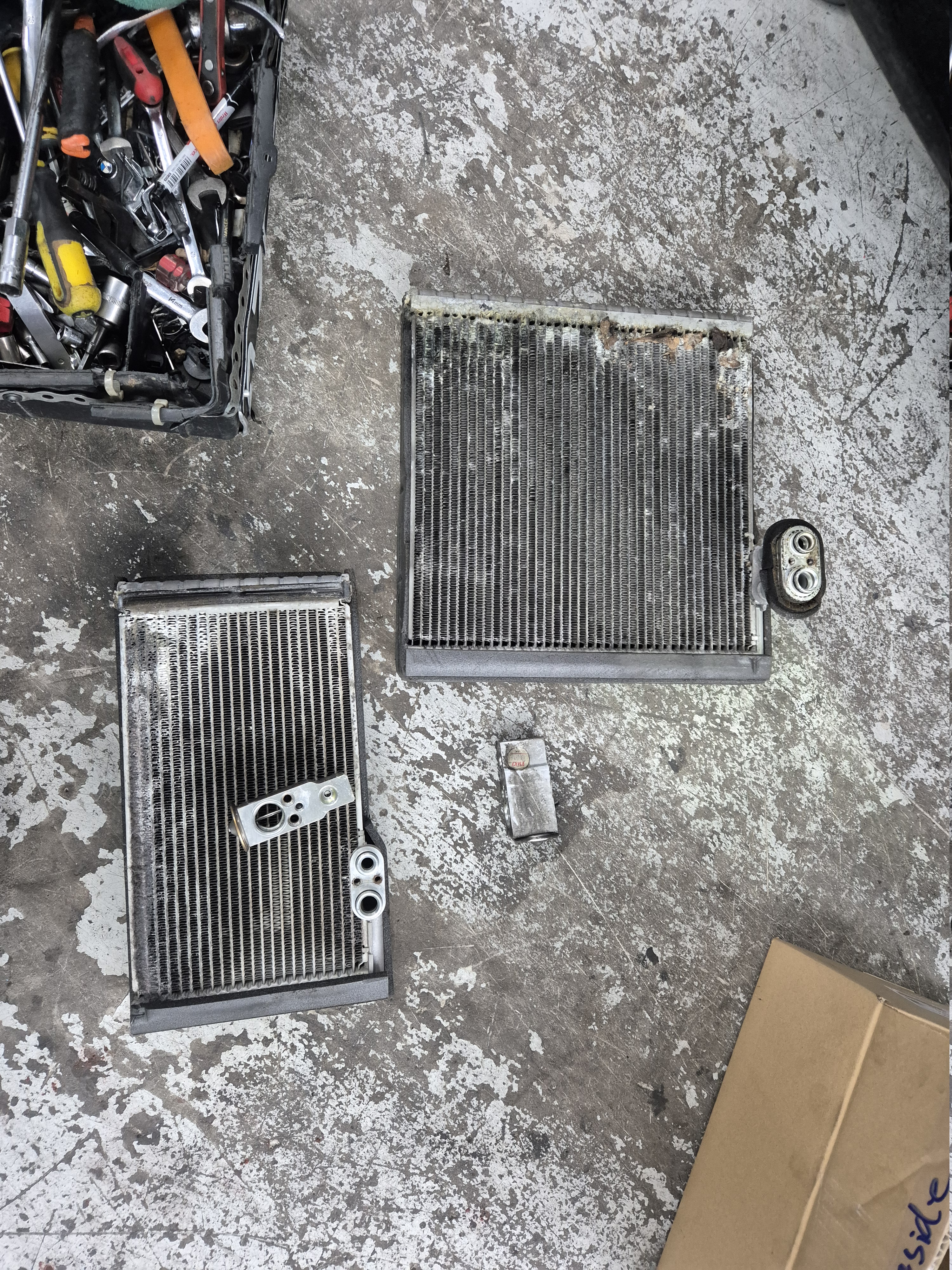
For example, a hypothetical aircon return after evaporator work calls for checking the earlier findings against current pressures, control operation and leak evidence—not automatically replacing another cooling coil. The removed evaporator photograph above illustrates component access only; appearance cannot identify why cooling returned warm. For engine symptoms, our diagnostic-fee guide explains how investigation differs from buying a replacement part.
Any road test must follow a safety assessment and be carried out appropriately by the technician. Some intermittent faults need longer observation or a later reassessment. Ask what remains unconfirmed and what information would change the recommendation. “Could not reproduce today” is a limitation to document, not proof that the complaint never occurred.
Will the return inspection or repair cost anything?
That depends on the written repair terms, what was originally authorised and what the reassessment finds. Do not assume either that everything is free or that a second charge is automatically justified. Ask whether inspection is covered, whether further diagnostic time needs approval, and whether a proposed part, labour or recovery charge is separate. Request the amount in SGD and clarify GST before authorising work.
Read our repair-warranty questions and set clear limits for additional authorisation. A different fault is not automatically covered by the first repair, and an expired commercial warranty does not by itself settle every question about responsibility. This is practical preparation, not a legal finding or a blanket Edwin Garage warranty promise.
Prevent another unclear handover
Before collecting the car, ask for the confirmed cause, completed work, verification performed and any outstanding limitations in writing. Agree what to monitor and whom to contact if symptoms recur. Keep service records and follow the vehicle-specific maintenance schedule; avoid unapproved additives or modifications offered as a shortcut around diagnosis.
If the explanation remains unclear, an evidence-based second opinion can help compare findings and scope. Preserve the first workshop’s paperwork and allow it a reasonable opportunity to respond where appropriate. A second workshop should assess evidence independently, not declare fault simply because the car was repaired elsewhere. More guidance is available in our Singapore car-owner guides.
Arrange a documented assessment, not another guess
At Edwin Garage in Ang Mo Kio, send the model, year, symptoms and previous invoice details as an enquiry before arranging a visit. Routine diagnostics, inspections and checks are appointment only, booked exclusively online. WhatsApp is for enquiries, not bookings or remote driving-safety clearance. Genuine breakdown, no-start, overheating or accident emergencies may be exceptions subject to availability; contact us first and arrange recovery when needed. Open Monday–Saturday, 10am–8pm; closed Sundays.
Book an assessment onlineShould I return to the original workshop first?
Contact it promptly with the invoice and recurrence details, provided doing so does not delay urgent recovery or emergency help. Ask how it will reassess the original complaint and whether further charges need approval. Do not drive an unsafe car back merely because the workshop is nearby.
Does the same warning code prove the replacement part failed?
No. A code describes a detected condition, not necessarily a failed component. Wiring, supply voltage, operating conditions or another fault may produce the same code. Compare recorded evidence before and after repair rather than replacing the named part automatically.
Is a repeat repair always covered by warranty?
No blanket answer is possible. Coverage depends on the written terms, original scope and supported cause of the recurrence. Ask about inspection, parts, labour and approval before further work; do not assume that a new or related fault is automatically included.
Should I clear the light before the return visit?
Do not erase codes or disconnect the battery just to remove the warning. Useful stored information may be lost on some vehicles. Record symptoms safely and tell the technician about any previous reset; a cleared warning is not evidence that the car is repaired or safe.
Can Edwin diagnose a returning problem through WhatsApp?
WhatsApp can help clarify the history and suitable next steps, but it cannot establish the fault or certify driving safety. Routine checks require an appointment booked online. Genuine urgent emergencies are subject to availability, and Edwin Garage is closed Sundays.
Key Takeaways
- Contact it promptly with the invoice and recurrence details, provided doing so does not delay urgent recovery or emergency help. Ask how it will reassess the original complaint and whether further charges need approval. Do not drive an unsafe car back merely because the workshop is nearby.
- No. A code describes a detected condition, not necessarily a failed component. Wiring, supply voltage, operating conditions or another fault may produce the same code. Compare recorded evidence before and after repair rather than replacing the named part automatically.
- No blanket answer is possible. Coverage depends on the written terms, original scope and supported cause of the recurrence. Ask about inspection, parts, labour and approval before further work; do not assume that a new or related fault is automatically included.
- Do not erase codes or disconnect the battery just to remove the warning. Useful stored information may be lost on some vehicles. Record symptoms safely and tell the technician about any previous reset; a cleared warning is not evidence that the car is repaired or safe.
Got a Question? Ask Edwin
Edwin Garage is located in Ang Mo Kio. Serving Hougang, Yio Chu Kang, Serangoon & surrounding areas.
WhatsApp Edwin Book Appointment