Thinking of buying a car part online and asking a workshop to fit it? Ask the workshop before ordering. A cheaper component is not automatically a cheaper completed repair: compatibility, diagnosis, installation requirements and responsibility if something goes wrong all matter. Customer-supplied parts are not automatically accepted, even when a listing says they fit your car.
At Edwin Garage, we want the repair decision to start with the fault and the required specification, not a shopping-cart screenshot. Our car servicing and repair workshop in Ang Mo Kio handles enquiries from drivers around Hougang, Yio Chu Kang and Serangoon. This guide explains what to clarify; it is not a promise that we will install a particular owner-supplied part.
What does bringing your own car parts actually involve?
You source the component separately and ask a workshop to assess whether it can undertake the fitting. The seller, installer and person diagnosing the fault may then be different parties. Their responsibilities do not automatically merge. A seller saying “replacement warranty” does not necessarily mean removal, refitting, diagnosis or vehicle recovery is included.
There are two separate decisions: whether the proposed part is appropriate, and whether replacing it addresses the proven fault. A correctly catalogued starter motor will not cure a poor electrical connection. Replacing an aircon compressor without assessing the rest of the system can leave the cause unresolved. Read our diagnostic-fee guide before treating fitting labour as the entire job.
Warning signs to notice before placing an order
- The seller confirms fitment from the model name alone, without checking the vehicle variant or a relevant part reference.
- The listing uses one photograph for multiple specifications, or its connector, mounting or pulley information is unclear.
- A warning code is presented as proof that one component must be replaced.
- Return conditions become invalid after opening packaging or attempting installation.
- Neither party can explain who handles a suspected defective part or repeated labour.
None of these proves that a part is defective or a seller dishonest. They are reasons to pause and obtain clarification. Keep the listing, invoice, seller messages and return terms. Do not remove labels or protective plugs simply to compare appearances, and do not install a questionable safety-related component to “see whether it works”.
Why parts that look identical may not be interchangeable
A registration year or familiar badge does not uniquely identify every fitted component. Engine and transmission variants, production changes, electrical connectors, control software and previous repairs can matter. A vehicle identification number and the removed part's reference can help a competent supplier, but neither replaces the necessary technical checks.
Electrical components can have different output ratings or control interfaces despite similar housings. A compressor may require the correct oil and refrigerant-system compatibility; an electrically driven hybrid or EV compressor introduces additional insulation and high-voltage considerations. Brake components, sensors and suspension parts may also differ within a model range. Owners should not investigate live electrical or high-voltage systems themselves.
Even a matching number needs context: it might identify an old version superseded by another, or a label might be unreliable. Ask how the supplier confirmed suitability and whether that confirmation is in writing. A workshop may reasonably decline fitting when provenance, compatibility or safe installation cannot be established.

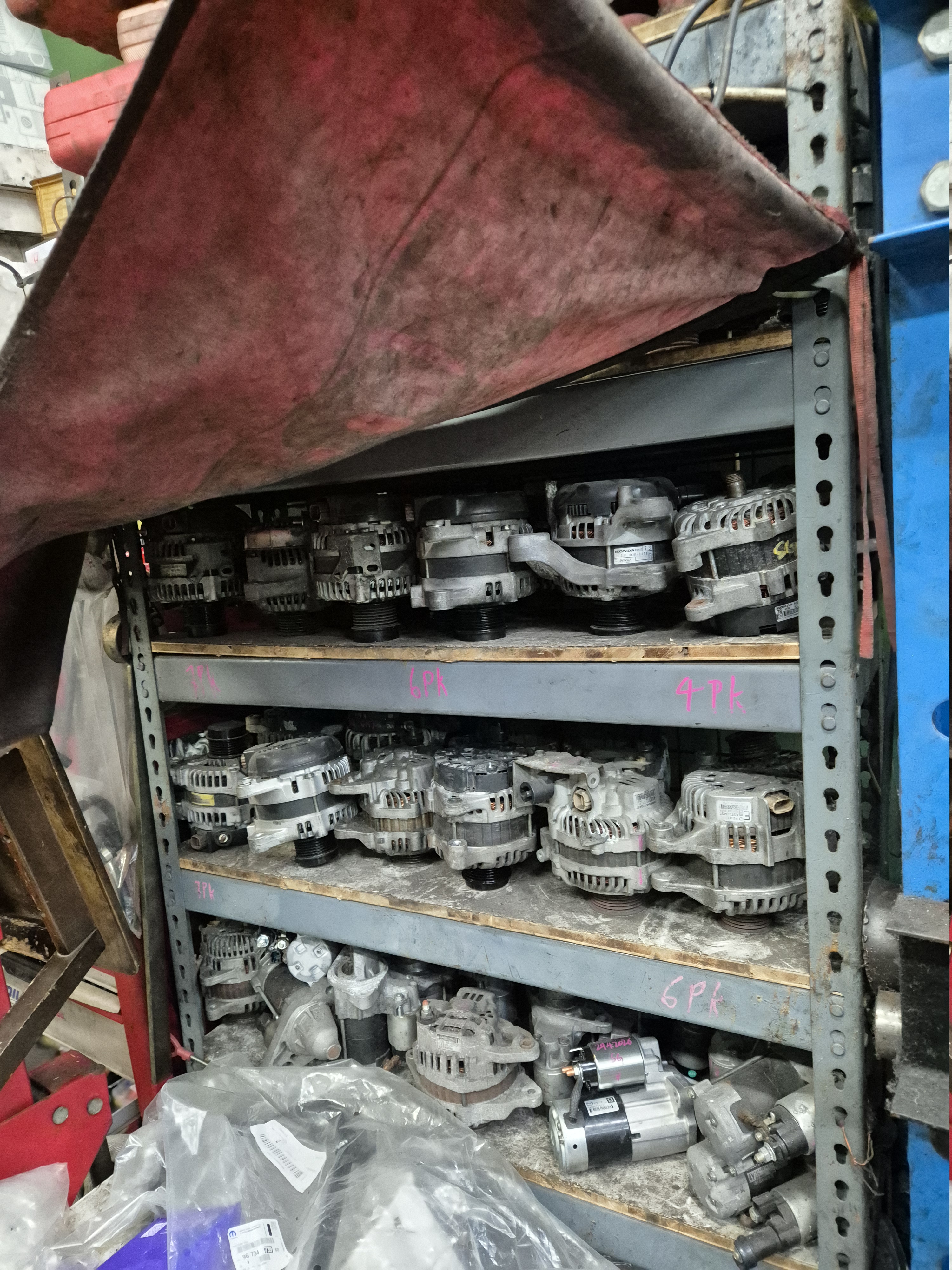
Authentic workshop photo of stored removed automotive components, including aircon compressors. It illustrates component variety, not proof that any pictured unit is tested, available for sale or suitable for your vehicle.
New, aftermarket, used and remanufactured are different descriptions
“OEM quality” on a listing is not enough to establish manufacturer identity, origin or performance. Ask exactly who made the part and what documentation accompanies it. New aftermarket parts vary by manufacturer and application. Used parts have a prior service history that may be incomplete. Remanufactured should describe a rebuilding and testing process, not merely a cleaned appearance.
Our guide to remanufactured versus second-hand components explains the distinction. For aircon work, compare the whole repair scope in our remanufactured versus new compressor guide. No category is automatically the right choice for every vehicle or use.
What should happen before a workshop agrees to fit it?
- Describe the actual complaint. Share symptoms, warning messages, when they occur and relevant previous work. Avoid unsafe test drives or repeated starting just to gather evidence.
- Agree on assessment first. Ask what diagnosis is needed and what it costs before purchasing a proposed cure.
- Provide the proposed part details. Include manufacturer, reference, seller information and clear photographs where requested; do not post sensitive vehicle documents publicly.
- Confirm acceptance and scope. Clarify labour, associated consumables, programming or calibration, and what happens if the part proves unsuitable.
- Authorise work in writing. Specify approval limits and the point at which the workshop must pause and contact you.
This is a discussion checklist, not an inspection guarantee or a list of services included with every fitting. Our repair-authorisation guide helps keep the agreed scope clear. Do not arrange delivery to the workshop or assume a fitting slot exists without confirmation.
Compare the total SGD scope, not the part price alone
Request an itemised quote in Singapore dollars. Compare diagnosis, component cost, fitting labour, required seals or fluids, disposal or core-return arrangements where applicable, coding or calibration if required, and GST treatment. Confirm which items apply rather than assuming all are needed. A seller's displayed price may exclude delivery, import-related charges or return freight.
Ask separately about costs if the delivered part is wrong, the vehicle cannot be reassembled promptly, or a later fault needs investigation. Do not assume that repeated labour is free or that it is always chargeable: the cause, agreement and applicable rights matter. A universal labour price would be misleading without knowing the vehicle, access and job requirements.
For a hypothetical driver in Hougang, a low online price could cease to be attractive if a wrong connector means returning the unit and arranging alternative transport. That is an illustration, not a reported customer case. Our waiting-for-parts guide covers the practical questions to ask about delays.
Clarify warranty and responsibility before installation
Ask who warrants the supplied component and who stands behind the agreed installation work. Record the coverage period, exclusions, claim procedure, evidence required and responsibility for removal or refitting. Separate a supplier defect, installation issue and unrelated vehicle fault; a repeat symptom alone does not establish which occurred.
Do not accept a verbal “no warranty” or “full warranty” as a complete explanation. Written terms need to be understood alongside any applicable legal rights; this article is not legal advice. Keep the original part where practicable and agreed, packaging and work records until the issue is resolved. Our repair-warranty questions help structure that conversation.
Misconceptions and when to seek help instead of shopping
“A fault code tells me exactly what to buy.” A code identifies a monitored condition, not necessarily a failed component. “If it bolts on, it is compatible.” Mechanical fit alone does not prove correct electrical, hydraulic or software operation. “A supplied part must save money.” Compare completed scope and responsibilities, not just purchase price.
Do not delay urgent help while waiting for a parcel. Reduced braking, sudden steering difficulty, overheating warnings, smoke, fuel smell or a severe new vibration require stopping safely and not continuing where safety is in doubt. Arrange suitable recovery. A booking request or WhatsApp message is not an emergency-response service. Avoid DIY fuel, air-conditioning refrigerant or high-voltage work.
Enquire before buying; book assessment online
At Edwin Garage, the useful first question is “What evidence and specification do we need?” rather than “Can you fit this tomorrow?” For a proposed owner-supplied part, enquire first; acceptance and timing need individual confirmation. Routine diagnosis, inspections and checks are appointment only, booked exclusively online. WhatsApp is for enquiries, not booking.
Book an assessment online Enquire about a proposed part
We are in Ang Mo Kio, open Monday–Saturday, 10am–8pm, closed Sundays. Genuine breakdown, no-start, overheating or accident emergencies may be considered subject to availability; this does not promise immediate attendance or parts fitting. Browse our Singapore car repair guides for related decision checklists.
Can I bring my own parts to Edwin Garage?
Enquire before buying or delivering a part. Acceptance depends on the proposed job, compatibility, provenance and agreed responsibilities; this guide does not confirm a blanket customer-supplied-parts service. Routine assessment requires an online appointment.
Will buying my own car parts make the repair cheaper?
Not necessarily. Compare diagnosis, delivery, fitting, required consumables, any necessary programming and the consequences of wrong or defective parts. Request an itemised SGD scope before deciding rather than comparing component prices alone.
Does a matching model and year guarantee that a part fits?
No. Engine variant, production changes, connectors and control requirements may differ within the same model year. Have a competent supplier and installer assess the relevant vehicle and part specifications before committing.
Who handles warranty if I supply the component?
Clarify component coverage with the seller and installation responsibilities with the workshop in writing. Ask specifically about diagnosis, removal and refitting if a problem occurs. A repeated symptom does not by itself identify responsibility or remove applicable rights.
Should I buy a replacement just because a scanner shows a code?
No. A code is a diagnostic starting point, not a shopping instruction. Wiring, supply voltage, mechanical conditions or another system can cause a monitored fault. Establish the cause before ordering and never keep driving an unsafe vehicle to complete tests.
Key Takeaways
- Enquire before buying or delivering a part. Acceptance depends on the proposed job, compatibility, provenance and agreed responsibilities; this guide does not confirm a blanket customer-supplied-parts service. Routine assessment requires an online appointment.
- Not necessarily. Compare diagnosis, delivery, fitting, required consumables, any necessary programming and the consequences of wrong or defective parts. Request an itemised SGD scope before deciding rather than comparing component prices alone.
- No. Engine variant, production changes, connectors and control requirements may differ within the same model year. Have a competent supplier and installer assess the relevant vehicle and part specifications before committing.
- Clarify component coverage with the seller and installation responsibilities with the workshop in writing. Ask specifically about diagnosis, removal and refitting if a problem occurs. A repeated symptom does not by itself identify responsibility or remove applicable rights.
Got a Question? Ask Edwin
Edwin Garage is located in Ang Mo Kio. Serving Hougang, Yio Chu Kang, Serangoon & surrounding areas.
WhatsApp Edwin Book Appointment