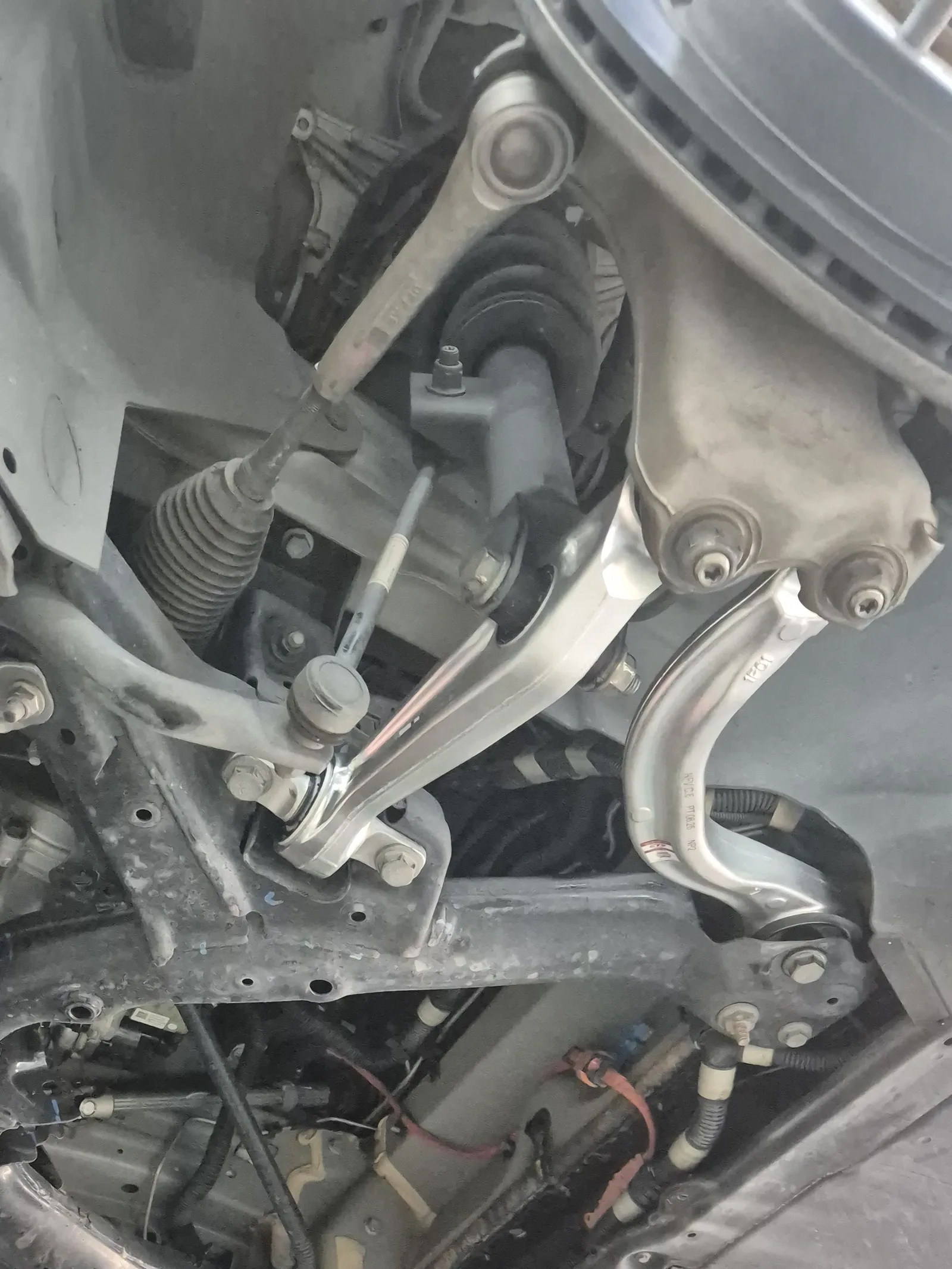
Yes, a Tesla still needs periodic servicing. It needs no engine-oil changes or routine petrol-car-style gearbox-oil service, so there is less maintenance than on a petrol car, but tyres, brakes, suspension bushings, wheel bearings, the cabin filter and the heat exchanger still wear or clog. These parts keep the car safe, so they still need checking.
We are Edwin Garage, a car workshop in Ang Mo Kio that also services Tesla and other EVs. Many Tesla owners tell us the same thing: "It's electric, so there's nothing to service." This page explains what is reduced, what is not, and what we check when a Tesla comes in. Your Tesla Owner's Manual and the car's own Maintenance screen always come first.
WhatsApp Edwin about Tesla servicing
Is a Tesla maintenance-free?
No. Tesla's own Vehicle Maintenance page says the car does not require annual maintenance or regular fluid changes, and needs no traditional oil changes, spark plugs or emission checks. Tesla's Singapore Service page also describes no regularly required maintenance. That is true for the engine side, because there is no engine.
But a Tesla is still a heavy car on four tyres, with brakes, steering, suspension arms, rubber bushings and bearings. Those parts wear the same way on any car, and on a heavy EV with instant torque some of them work harder. Less maintenance is not the same as no maintenance.
| Petrol car item | On a Tesla |
|---|---|
| Engine oil and filter | Not needed: no engine |
| Gearbox oil | No regular gearbox oil change like an ICE car |
| Spark plugs, fuel system | Not needed |
| Tyres, brakes, suspension, bushings, bearings, alignment, cabin filter | Still needed, see below |
What still needs servicing on a Tesla?
This is the list we work through on a Tesla service. Where Tesla publishes an interval, we quote it from the Vehicle Maintenance page. Where Tesla does not, the item is an inspection item: we check it and replace it only when it is worn.
1. Tyres: wear, rotation and pressure
Tyres carry all of the car's weight and torque, so they are the first thing we look at. We check tread depth across each tyre, uneven wear on the inner or outer edge, sidewall damage and pressure. Tesla's Vehicle Maintenance page recommends rotating the tyres every 6,250 miles (about 10,000 km), or sooner if the tread depth between two tyres differs by 2/32 inch (about 1.5 mm) or more. Set cold tyre pressure to the figure on the door-pillar label or in your Owner's Manual. Rotate only where the wheel sizes, tyre direction and model instructions permit it; staggered front/rear fitments may not be interchangeable. If a tyre is damaged, see tyre puncture: repair or replace.
2. Brake pads and brake fluid
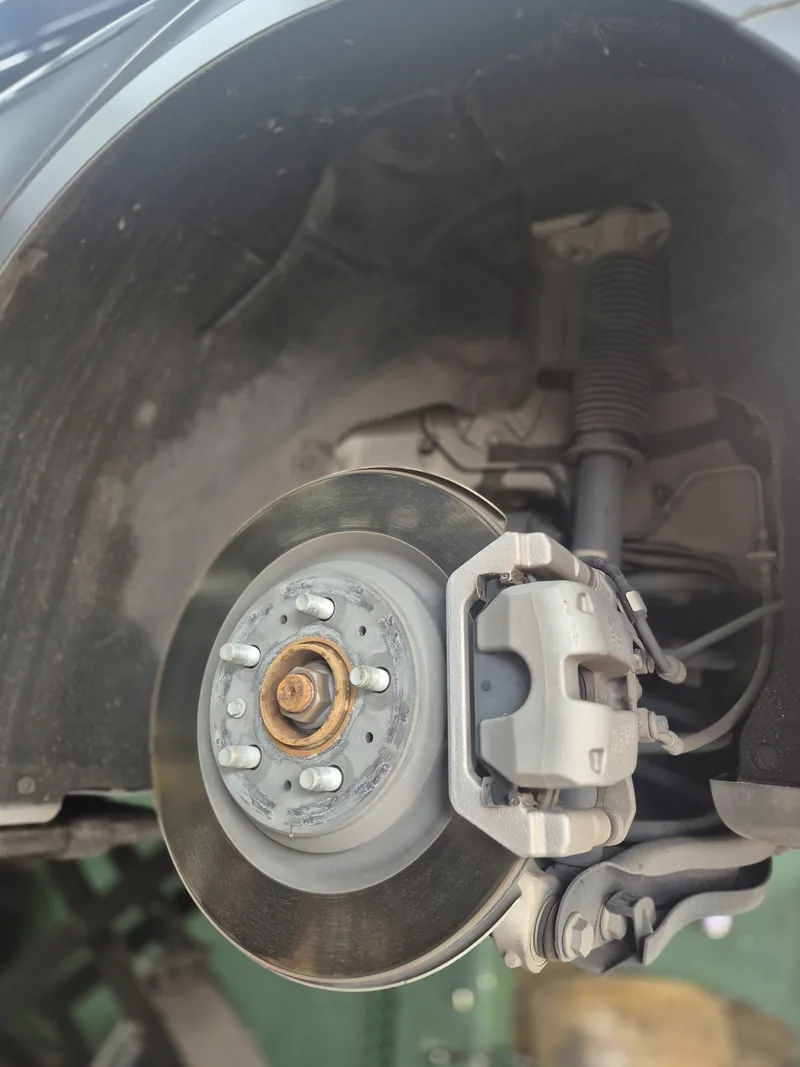
Regenerative braking does much of the slowing, so pads usually last longer than on a petrol car. They are still consumables and still wear, and pads that sit unused can corrode or stick. We measure pad thickness, look at the discs and check the caliper movement. More on pad wear in when to replace brake pads.
For brake fluid, Tesla recommends testing it for contamination every 4 years and replacing it as needed, and says hot and humid environments may need more frequent checks. Singapore is both hot and humid, so we test it at service.
3. Lower control arms and their bushings
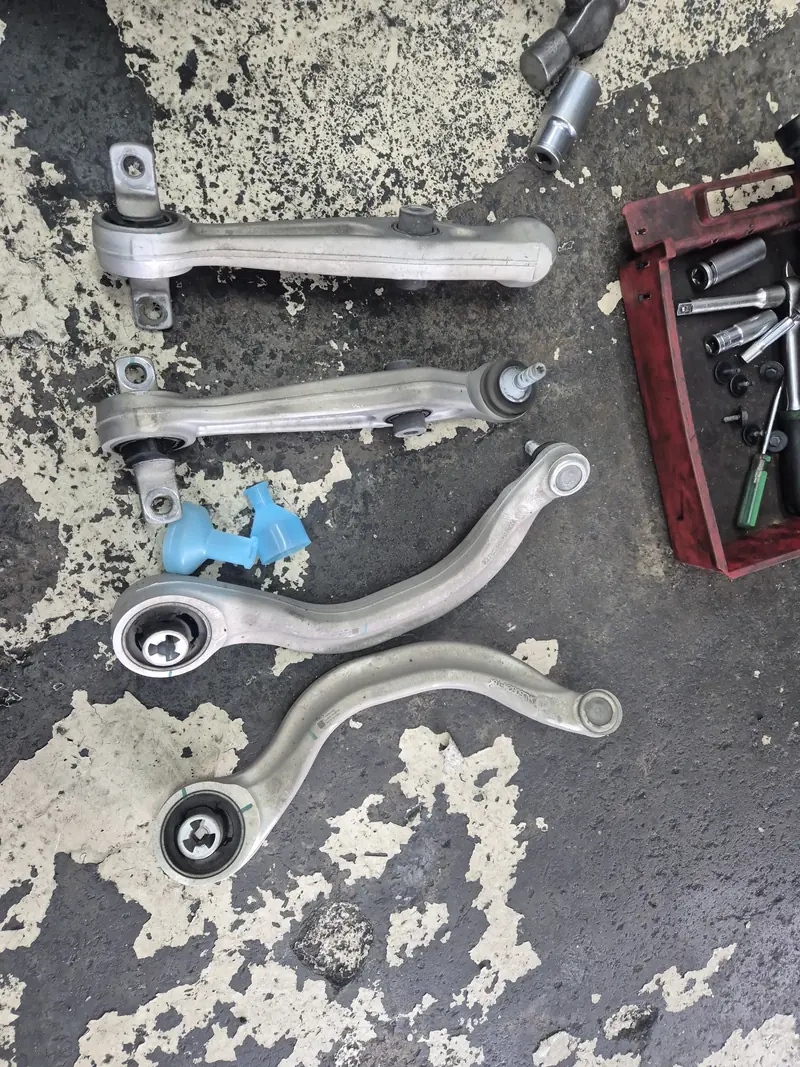
The lower control arms hold the wheel in place. Each arm sits on rubber bushings that soak up bumps and keep the wheel at the right angle. On a heavy EV, years of HDB carpark ramps, humps and potholes slowly tear and crack that rubber. Tesla gives no fixed replacement interval for these, so we inspect them at every service.
Signs of worn bushings: a knock or clunk over humps, a wandering or vague steering feel, and tyres wearing on one edge.
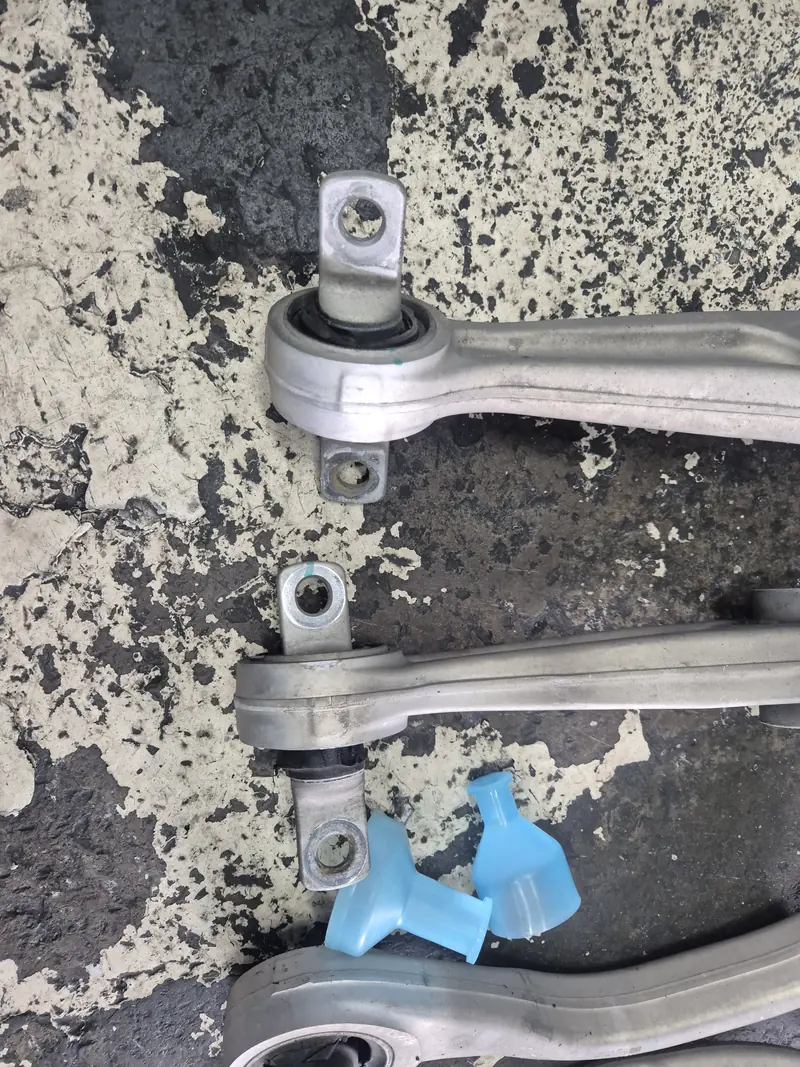
Below is what worn bushings look like once they come off the car. The rubber is torn, split or pulled away from the inner sleeve, so the arm can move when it should not.
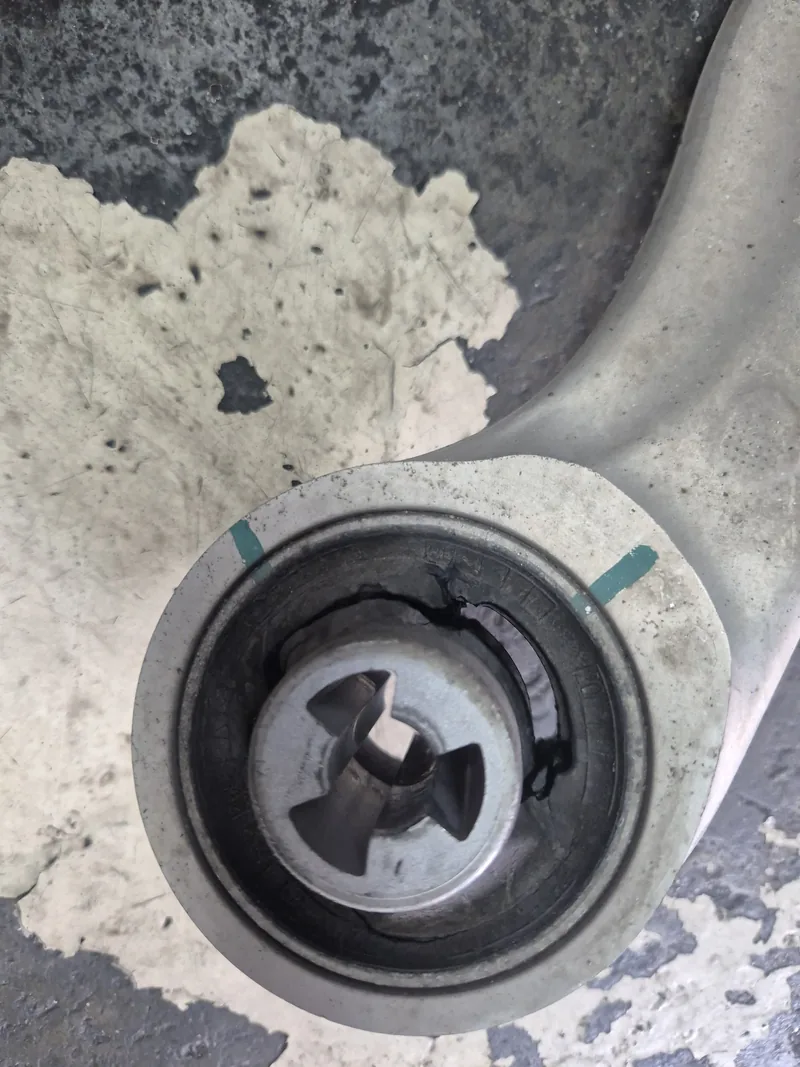
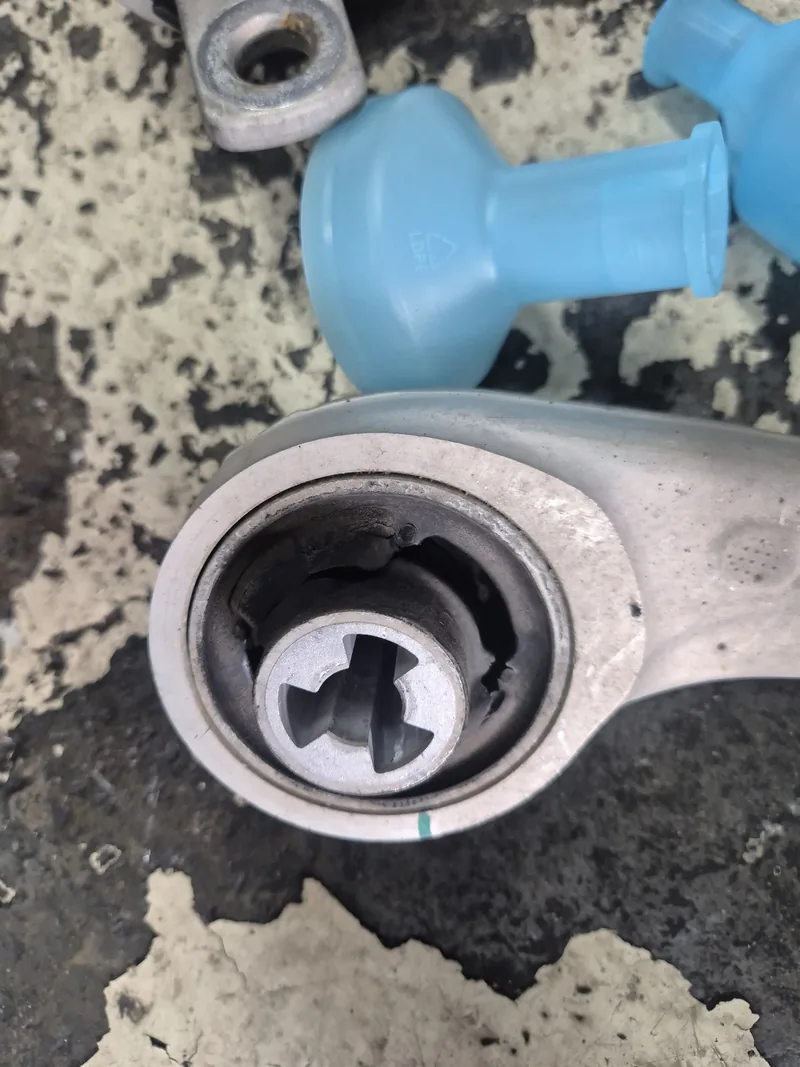
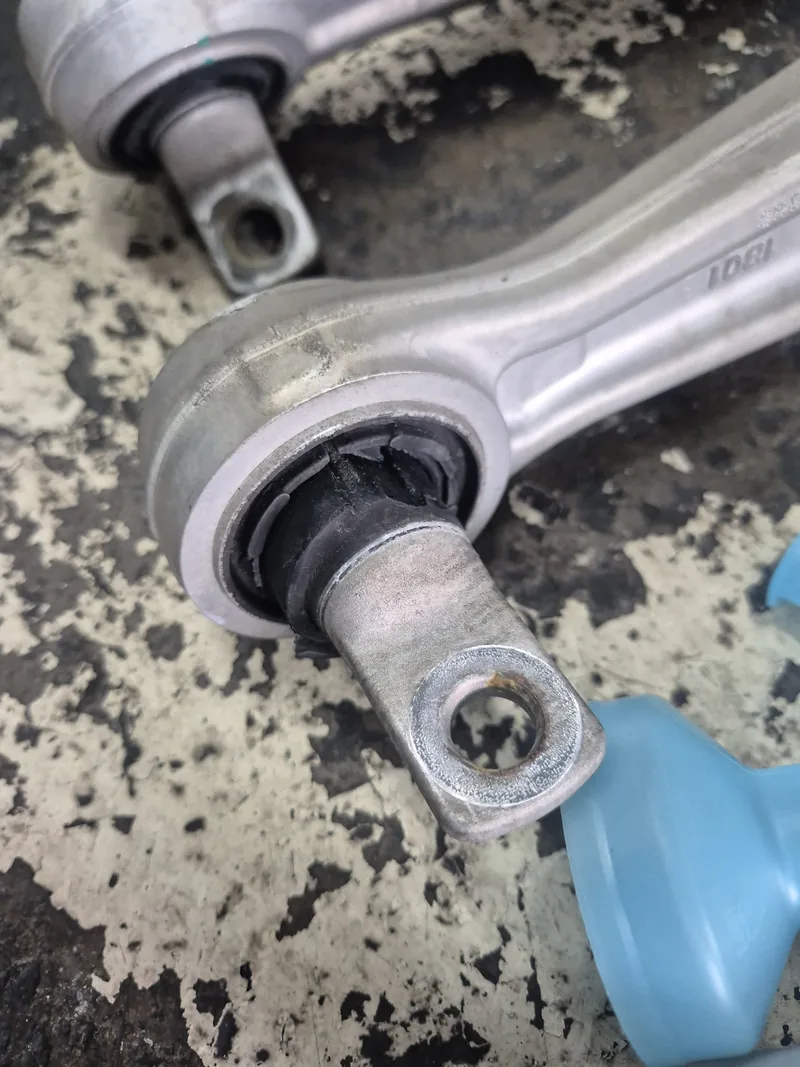
All three were removed during servicing at our workshop.
For the full repair, signs and what replacement involves, read our Tesla lower control arm replacement guide. Our Tesla maintenance case study also shows a lower arm job on one car.
4. Wheel bearings
Wheel bearings carry the car's weight at each wheel. A worn bearing usually starts as a hum or growl that rises with speed and changes when you turn. On a quiet EV you often hear it sooner, because there is no engine noise to cover it. There is no official interval: we check for play and noise with the wheel off the ground. See wheel bearing noise.
5. Cabin filter
Tesla's Vehicle Maintenance page says to replace the cabin air filter every 2 years on Model 3 and Model Y, and every 3 years on Model S and Model X (every 2 years for Model S and Model X built 2012 to 2020). If your car has a HEPA filter and carbon filter, Tesla recommends replacing those every 3 years. Tesla also notes the schedule can vary, so open Controls > Service > Maintenance on the touchscreen and check your Owner's Manual.
Singapore heat, humidity, haze and leafy carparks can clog a filter sooner. A weak or musty aircon is a sign to check it before the date comes. Our Tesla maintenance case study shows a cabin filter change on one car, and the cabin filter guide covers any car.
6. Lubrication points: brake calipers and a clicking rear shaft
During servicing we inspect the brakes and, where the model-specific procedure requires it, clean and lubricate only the specified caliper contact or sliding points with the approved product. This is not an instruction to grease exposed pistons, friction surfaces or sealed components; lubricant must never contaminate pads or discs. Tesla notes that brake lubrication is not required for Model Y vehicles produced after February 2025. Tesla's page lists yearly brake cleaning and lubrication for areas where roads are salted in winter. Singapore does not salt its roads, so that interval is not a Singapore rule; for us it is a workshop check done during the service.
We also listen for a clicking from the rear driveshaft (rear axle shaft), often when pulling away or turning. Where we find it, we diagnose the shaft, joints and mounting interfaces and follow the applicable repair procedure; clicking is not proof that grease is the fix. Sealed joints are not a routine DIY lubrication point. This is a workshop inspection item, not a Tesla service interval.
7. Wheel alignment
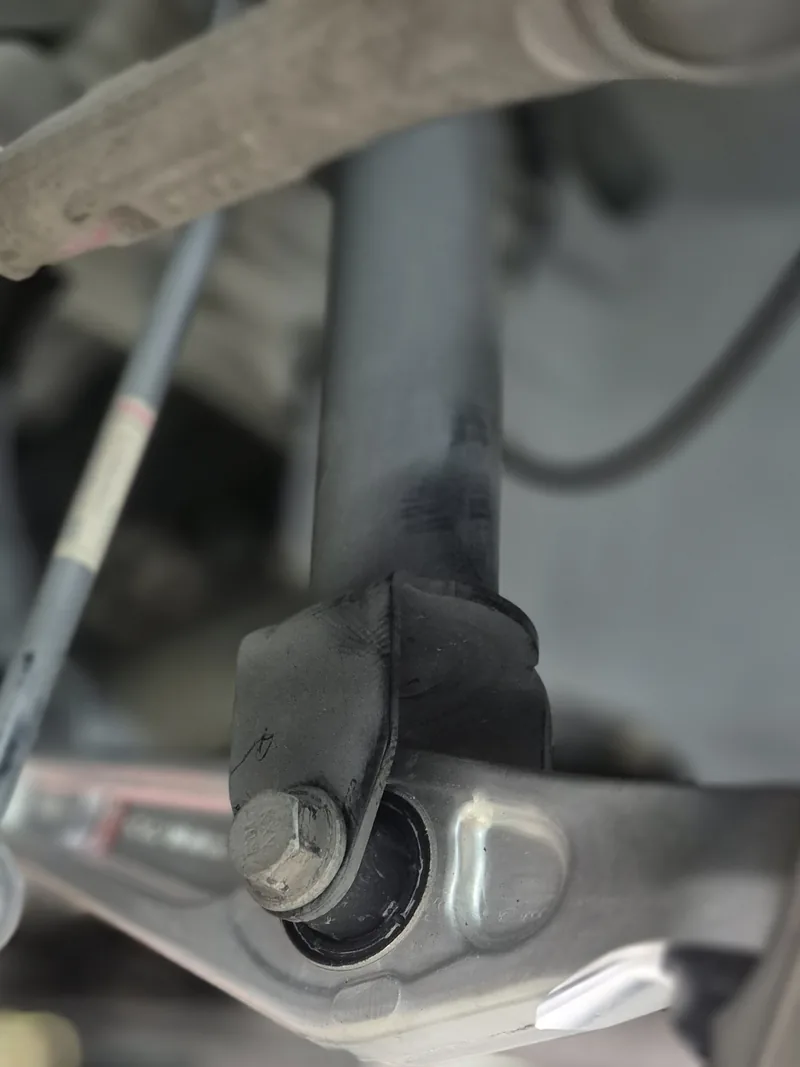
Alignment sets the angle of each wheel. When it drifts, the car pulls to one side and tyres wear on one edge, which is costly on EV tyres. Worn bushings throw the alignment out, and alignment should always be checked after lower arm or other suspension work. There is no fixed mileage for this: check it when you see uneven wear, a crooked steering wheel or a pull. See wheel alignment signs.
8. Radiator and heat-exchanger cleaning
A Tesla has no engine radiator in the usual sense, but it does have a heat exchanger at the front that cools the battery and aircon. Leaves and debris get trapped in front of it, especially in leafy estates, and that can lead to overheating.
At Edwin Garage, radiator cleaning is part of our Tesla servicing in years 3, 5, 7 and 9 of the car's life, to clear trapped leaves and debris. This is our own workshop schedule, not a Tesla official interval: Tesla's page lists radiator cleaning as "when needed". For how we do it and why leafy estates matter, read Tesla radiator and heat exchanger cleaning. The case study also shows leaves found in one car's frunk area.
How often should a Tesla be serviced?
Tesla does not set an annual service. Follow the Maintenance screen (Controls > Service > Maintenance) and your Owner's Manual for the timed items such as the cabin filter and brake fluid. For the wear items above, a regular inspection on the lift is how you catch a torn bushing or a worn pad before it becomes a safety problem. If you hear a new knock, hum or click, or the car pulls, get it checked sooner.
Where to service your Tesla
Owners can use Tesla's own service centre or an independent workshop. For what to weigh up, read independent servicing options for Singapore Tesla owners, and for our background with Tesla see Edwin Garage and Tesla repair. For accident or panel damage, see Tesla body repair.
Cost depends on what the inspection finds. We inspect first and quote before any work starts. There is no fixed Tesla package price; WhatsApp us to enquire. Cash and PayNow are preferred; credit cards have a 3% surcharge.
Book a Tesla inspection
Servicing at Edwin Garage in Ang Mo Kio is by appointment only, booked online. No walk-ins. WhatsApp 9785 6612 is for enquiries. Open Monday to Saturday, 10am to 8pm; closed Sundays. More on our car servicing and repair page.
Frequently asked questions
Is a Tesla maintenance-free?
No. Tesla vehicles need no engine-oil changes or routine petrol-car-style gearbox-oil service, but drive units still contain lubricants: follow model-specific instructions if there is a leak or repair. Tyres, brakes, suspension, wheel bearings and cabin filters still need attention. Follow the Owner’s Manual and Maintenance screen for the vehicle; reduced maintenance does not mean no maintenance.
What still needs servicing on a Tesla?
Tyres (wear, rotation, pressure), brake pads and brake fluid, lower control arms and bushings, wheel bearings, the cabin filter, brake caliper lubrication, any clicking rear shaft, wheel alignment and cleaning debris from the front heat exchanger.
How often should the Tesla cabin filter be changed?
Tesla's Vehicle Maintenance page says every 2 years on Model 3 and Model Y and every 3 years on Model S and Model X, with HEPA and carbon filters every 3 years where fitted. Check Controls > Service > Maintenance on the touchscreen and your Owner's Manual. Singapore heat, humidity and haze can mean checking it sooner.
Is Tesla radiator cleaning on Tesla's official schedule?
No. Tesla lists radiator cleaning as when needed. At Edwin Garage, radiator and heat-exchanger cleaning is part of our Tesla servicing in years 3, 5, 7 and 9 of the car's life, to clear trapped leaves and debris. That is our own workshop schedule.
How often should Tesla tyres be rotated?
Tesla's Vehicle Maintenance page recommends every 6,250 miles (about 10,000 km), or sooner if the tread depth between two tyres differs by 2/32 inch (about 1.5 mm) or more. Use the tyre pressure on the door-pillar label or in your Owner's Manual.
Does servicing at an independent workshop affect my Tesla warranty?
Warranty terms are set by Tesla, so check your own warranty documents or ask Tesla for your car. Keep a record of every service done. For the wider picture, see our guide to independent servicing options for Singapore Tesla owners.
Key Takeaways
- A Tesla needs no engine-oil changes; model-specific drive-unit lubrication requirements still apply. Maintenance is reduced, not removed.
- Tyres, brakes, lower arm bushings, wheel bearings, alignment and the cabin filter still wear and affect safety.
- Timed items (cabin filter, brake fluid test) come from Tesla's Vehicle Maintenance page and the in-car Maintenance screen.
- Radiator cleaning in years 3, 5, 7 and 9 is Edwin Garage's own workshop schedule, not a Tesla interval.
- Inspect first, quote before work: WhatsApp 9785 6612 to enquire, book online.
Is your Tesla due a check?
Edwin Garage is in Ang Mo Kio, serving Hougang, Yio Chu Kang, Serangoon and nearby. Servicing is by online appointment; WhatsApp is for enquiries.
WhatsApp Edwin Book AppointmentRelated Tesla guides
Last updated: