When a Tesla rolls into Edwin Garage in Ang Mo Kio, the exterior looks sleek — but behind the front fascia lies a hidden trap. When Edwin lifts off the front trunk assembly and peels back the bumper, owners are almost always shocked: the heat exchanger is buried under a thick carpet of dried brown leaves, twigs and grit. Most Tesla owners in Singapore have never opened this compartment, and few realise their Tesla radiator cleaning is a real maintenance item — not a myth left over from petrol cars.
What Is Tesla Radiator & Heat Exchanger Cleaning?
A Tesla doesn't have a traditional engine radiator, but it does have a front-mounted heat exchanger (radiator) that manages temperature for the battery pack, drive unit inverters and cabin heat pump. Air is drawn in through the lower front fascia, passes through a bank of fine aluminium cooling fins, and is expelled by electric fans. Tesla radiator and heat exchanger cleaning is the process of safely removing leaves, seed pods, dust and grime from this fin pack so air can flow freely again. In Singapore's tropical climate, this single component quietly does the work that an entire cooling system does in a petrol car — and it is almost never checked until something goes wrong.
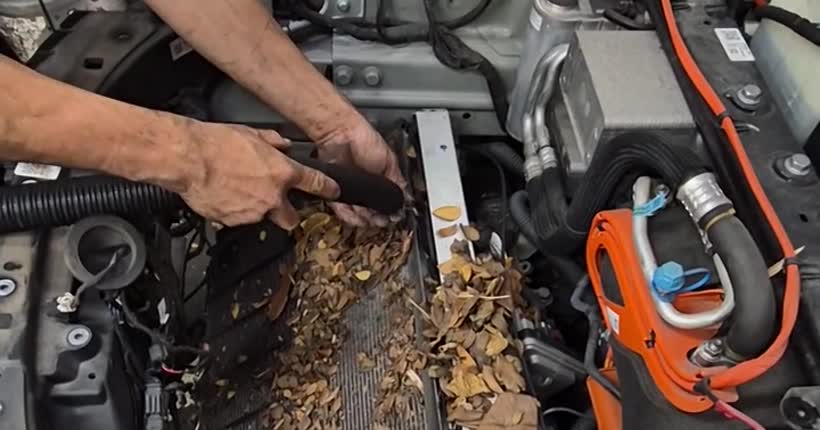
Before: 70–80% of the upper core buried in dried leaves and baked-on brown grime — a common sight when Edwin opens a Tesla frunk in Ang Mo Kio
Symptoms of a Clogged Tesla Radiator in Singapore
Because the heat exchanger sits out of sight behind the bumper, most owners only notice the downstream effects. Watch out for:
- Cooling fans running louder and more often, even on short drives around AMK, Hougang or Yio Chu Kang
- Weaker or slower cabin aircon cooling, especially when the car has been parked in the sun
- Faster-than-expected battery drain or reduced range on hot days
- A thermal management or reduced-power warning on the touchscreen or Tesla app
- A musty, damp-leaf smell coming from the frunk area
- Slower or less consistent DC fast-charging speeds in warm weather
Causes: Why Teslas Clog Up Faster Than Petrol Cars
This is not a manufacturing flaw — it is a design and environment mismatch. Three factors combine to make Tesla heat exchangers especially prone to clogging in Singapore:
- Low front intake position. Tesla's front fascia sits low and close to the ground, drawing in whatever is on the road surface — leaves, seed pods and fine grit — far more efficiently than a typical ICE car's higher grille.
- The frunk acts as a leaf trap. Because there is no engine block behind the fascia, debris that gets past the fins has nowhere to go and simply accumulates in the frunk cavity, out of sight and out of mind.
- Singapore's tropical tree cover. Mature rain trees and angsana along estates like Ang Mo Kio, Hougang, Yio Chu Kang and Serangoon shed leaves and seed pods year-round, not just seasonally. Combined with frequent rain, damp leaves stick to the fins instead of blowing through.
Left unaddressed, trapped leaves hold moisture directly against the aluminium fins, creating a slow corrosion risk in addition to blocking airflow — a double problem unique to this front-mounted layout.
The 3-Step Professional Cleaning Process
Edwin's process is surgical, not aggressive. High-pressure washing is never used, because it can flatten Tesla's fragile aluminium fins and permanently reduce their surface area. Instead, the job is done in three deliberate steps:
Watch: Edwin's 3-step Tesla radiator deep-clean — vacuum extraction, chemical mist, full core flush
Step 1: Precision industrial vacuum extraction
A crevice-nozzle industrial vacuum lifts every leaf, twig and seed pod out of the fin pack without ever making contact with the aluminium. This removes the bulk of the debris safely before any liquid is introduced.
Step 2: Low-velocity atomising chemical spray
A fine, low-pressure atomising mist penetrates deep between the fin rows to dissolve baked-on road grime and diesel soot that the vacuum alone cannot lift — again, without the water-hammer force that would bend or crush the fins.
Step 3: Angled core flush from behind the bumper beam
An angled flush lance, positioned from behind the bumper beam, forces clean water through the core from the opposite direction to the airflow. A drain pan underneath catches the dark, murky sludge that comes out — visual proof of how much had built up.
The result speaks for itself: what goes in as a core buried in dark brown baked-on grime comes out factory-silver aluminium, with every breathing channel fully open again. This is a multi-hour service requiring bumper and frunk removal — not a quick spray job — which is why it is rarely offered as a walk-in add-on elsewhere.
Prevention: How Often Should You Clean It?
For Tesla owners in Singapore's leafy estates, Edwin recommends:
- An annual heat exchanger inspection and clean as a baseline, timed alongside your Tesla maintenance check
- A visual frunk check every few months if you regularly park under trees in Ang Mo Kio, Hougang, Yio Chu Kang or Serangoon
- Earlier inspection if you notice louder fan noise, weaker aircon or a thermal warning — don't wait for the next scheduled service
Cost of Tesla Radiator Cleaning in Singapore
There is no honest fixed price without seeing the car, but as broad guidance: a routine annual clean with light debris is typically a more modest job, while a heavily clogged core requiring full bumper and frunk removal, vacuum extraction, chemical treatment and a complete flush sits at the higher end because of the labour involved. The exact quote depends on how long the debris has been building up, whether corrosion has started, and how much dismantling is needed for safe access. Edwin always shows the before-and-after so you can see exactly what was removed.
Frequently Asked Questions
Can I clean my Tesla radiator myself?
It's not recommended. The heat exchanger sits behind the bumper and frunk assembly, and reaching it safely requires partial disassembly. A garden hose or pressure washer can bend or flatten the aluminium fins, permanently reducing cooling performance — the opposite of what you're trying to achieve.
Will this void my Tesla warranty?
No. Routine cleaning and maintenance of wear items by a competent independent workshop does not void your Tesla's manufacturer warranty. This is preventive maintenance, not a modification.
How long does the service take?
Because it involves removing the front bumper and frunk liner to access the core properly, this is a multi-hour job, not a quick add-on during a regular service visit.
Does this affect the cabin aircon too?
Indirectly, yes. A clogged heat exchanger forces the whole thermal system to work harder, which can make the cabin heat pump and aircon feel weaker on hot days. If your aircon still feels warm after this service, see our guide on car aircon not cold for other possible causes.
Common Misconceptions
"My Tesla doesn't need maintenance."
Teslas skip oil changes, spark plugs and exhaust servicing, but they still have wear-and-maintenance items — cabin filters, suspension bushings, wiper blades and, critically, a heat exchanger that can physically clog with debris. "No engine" does not mean "no maintenance."
"A high-pressure wash is fine to clear it out."
This is one of the most damaging assumptions. High-pressure water can bend and flatten the delicate aluminium fins, permanently reducing the surface area available for cooling — turning a simple cleaning job into a costlier repair.
When to Seek Professional Help
Book an inspection promptly if you notice louder-than-usual fan noise, a thermal management warning on the touchscreen, reduced charging speed in hot weather, or a musty smell from the frunk. These are signs that airflow is already restricted, and the longer damp leaves sit against the aluminium fins, the greater the risk of corrosion rather than a simple clean. For the full picture on related overheating symptoms across all vehicle types, see our guide on engine overheating causes.
Edwin has been servicing Teslas since 2019 — before Tesla's official Singapore service centre operations began — and remains one of the few independent Tesla workshops in Singapore comfortable with this level of dismantling. If your Tesla needs body or panel work alongside this service, our Tesla body repair guide covers what to expect. For everything else your Tesla or any other vehicle may need, browse our full car servicing page.
Got a Question? Ask Edwin
Edwin Garage is in Ang Mo Kio. We serve Hougang, Yio Chu Kang, Serangoon & surrounding areas.
WhatsApp Edwin Book AppointmentKey Takeaways
- Tesla's front-mounted heat exchanger sits low and close to the road, making it far more prone to leaf and debris clogging than a petrol car's radiator.
- Warning signs include louder cooling fans, weaker aircon, reduced range, slower charging and a musty smell from the frunk.
- Edwin's 3-step process — vacuum extraction, atomising chemical spray, angled core flush — clears debris without damaging the fragile aluminium fins.
- High-pressure washing should never be used on a Tesla heat exchanger; it can permanently flatten the cooling fins.
- Annual inspection and cleaning is recommended for Tesla owners in leafy estates like Ang Mo Kio, Hougang, Yio Chu Kang and Serangoon.
Related Reading
Notice Louder Fans or Weaker Aircon in Your Tesla?
Book an inspection online or WhatsApp Edwin with photos of your frunk area — no phone bookings, ever.
WhatsApp Edwin Book Online