
A red oil-can warning is not a routine service reminder. Safely pull over, switch the engine off and do not keep driving to see whether the light goes away. Low oil level is one possible cause, but not the only one. Our car servicing and repair workshop in Ang Mo Kio checks the level, warning circuit and actual pressure before recommending a repair.
Symbols and warning behaviour vary by vehicle. Slow, hot CTE or PIE traffic may expose a marginal condition, but warm weather alone does not diagnose it. Here are safe next steps, causes, testing and cost factors.
What an engine oil pressure warning means
Engine oil is circulated under pressure through galleries to lubricate bearings, camshafts and other moving components. The red oil-pressure warning usually means a sensor or switch has detected pressure below the vehicle’s threshold. It does not measure how much oil is left in the sump, and it does not identify which part has failed.
Oil level and pressure are different: a normal dipstick can coexist with a pump, pickup, filter, oil-specification or internal-wear problem. Some cars show a separate level warning, so check the exact symbol in your manual.
Warning signs that may accompany low oil pressure
- A red oil-can symbol or a dashboard message such as “low oil pressure”.
- The light flickers at a hot idle, then goes out when engine speed rises. This still needs prompt attention; it is not proof of a harmless sensor issue.
- New tapping, ticking, rattling or deep knocking from the engine. Noise can indicate that parts are not receiving adequate lubrication.
- Oil visibly below the dipstick minimum, an oil puddle, or fresh wetness around the engine. A leak or oil consumption may have lowered the level.
- The warning stays on after starting, returns soon after topping up, or appears with sudden rough running or loss of power.
An electrical fault is possible, but treat a red pressure warning as genuine until checked. See our dashboard warning-light guide and your manual.
What to do when the oil pressure light comes on
- Move to a safe place. Signal and leave moving traffic when it is safe to do so. Do not brake suddenly or stop in a live lane just to inspect the dashboard.
- Switch the engine off. A warning that remains on while the engine runs can mean lubrication is inadequate. Continuing to drive can turn a repairable fault into severe engine damage.
- Wait and check the manual. If the vehicle is safely parked on level ground and the manual permits a dipstick check, allow time for oil to settle and follow the stated procedure. Keep clear of hot components and traffic.
- Check the level only if safe. If it is below minimum and there is no obvious major leak, use only the oil specification stated for the car and add in small amounts, rechecking the dipstick. Do not overfill. Topping up is not a diagnosis or a fix for a pressure fault.
- Do not restart if the warning persists. If the level is correct, the light stays on, there is an oil leak or the engine is making unusual noise, arrange safe recovery and a professional check. Do not drive an unsafe vehicle to the workshop.
Illustrative scenario, not a report of a particular customer repair: A driver from Hougang sees the red oil symbol flicker after a slow, hot commute toward Ang Mo Kio. The level appears normal. That is not enough to blame a pressure switch or continue driving; the engine should be switched off and actual pressure checked against the maker’s specification.
Common causes and how a workshop narrows them down
Without vehicle-specific data, an exact Singapore failure ranking would be misleading. A practical check order moves from simple causes to the oil system and engine condition:
- Low oil level from a leak or consumption: insufficient oil can allow the pump to draw air, particularly under acceleration, braking or cornering. The source may be an external leak or oil burning internally; topping up does not identify which.
- Oil specification, condition or filter issue: oil that does not match the manufacturer’s viscosity/specification, an incorrect filter, or a service-related installation problem can affect circulation. The Singapore climate does not justify choosing a thicker oil without checking the manual.
- Pressure sensor, switch, wiring or connector: a faulty sender or damaged circuit can give a false warning. A technician checks the wiring and compares the signal with measured pressure rather than replacing the sensor solely because the light appeared.
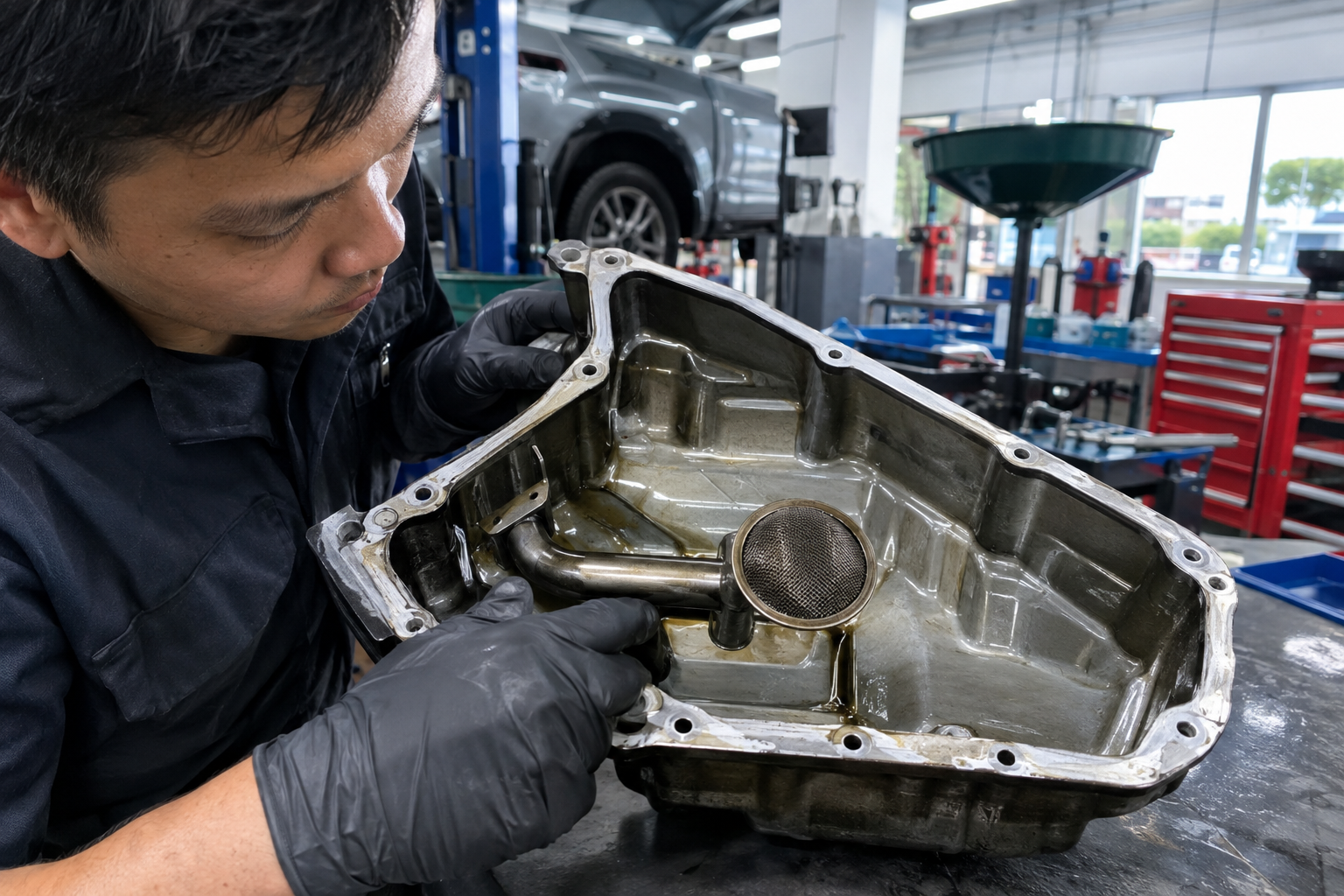
- Oil pickup restriction or pump fault: a blocked pickup strainer, damaged pickup seal or worn pump may reduce supply. Confirmation may require additional testing or inspection, depending on the engine design.
- Internal engine wear: worn bearings or excessive clearances can reduce pressure, particularly when hot. Knocking or tapping increases concern, but noise alone cannot identify the failed component.
For broader maintenance context, see our guide on what can happen when an engine oil change is skipped. A pressure warning is different from an overdue-service reminder, and one should not be treated as proof of the other.
How oil pressure is checked before parts are replaced
A workshop records the warning, when it appears, recent oil service, level, leaks and noise. Routine diagnostics, checks and inspections are strictly by online appointment. If the car is unsafe or broken down, arrange recovery; WhatsApp is for enquiries about safe next steps and availability, not bookings.
- Confirm the correct oil grade and level using the vehicle’s prescribed procedure; inspect for leakage and verify the filter and recent service work where relevant.
- Read applicable fault codes and inspect the pressure-switch circuit, connector and wiring. A code or warning is evidence to investigate, not automatic proof that a sensor needs replacement.
- Where appropriate, fit a calibrated mechanical pressure gauge at the specified test point and compare readings at the engine temperatures and speeds in the manufacturer’s procedure. The correct figures vary by engine.
- If measured pressure is low, investigate oil supply, pickup, pump and internal clearances as the results indicate. Some checks require removing components; they should be explained before work proceeds.
- After repair, verify pressure and warning-lamp operation under the relevant conditions, inspect for leaks and confirm the correct oil level. We explain the finding and estimate before proceeding with additional repairs.
If the dashboard also shows a temperature warning, that is a separate system to assess; our radiator-fan guide explains one possible cooling-system symptom without assuming it is the cause of an oil warning. Engine noises and performance symptoms can also have other causes; see how engine misfiring is diagnosed.
Prevention for Singapore driving
- Follow the vehicle maker’s oil grade, specification and service interval, adjusted only as its guidance allows for your driving conditions.
- Check the oil level at the interval and by the method in the owner’s manual; a visual look under the bonnet is not a pressure test.
- Ask for the oil and filter specification to be recorded after servicing. Keep invoices and mileage notes so an overdue change or repeated top-up is less likely to be missed.
- Watch for recurring oil spots after parking in a sun-exposed HDB carpark and have a suspected leak assessed rather than repeatedly topping up.
- Do not ignore a pressure light because it disappears at higher revs, after a restart, or during cooler early-morning travel. Intermittent warnings still deserve diagnosis.
Singapore heat and stop-start traffic may expose an existing problem; they do not justify arbitrary shorter intervals or thicker oil. Follow vehicle-specific guidance.
Oil pressure warning repair cost in Singapore: what affects the estimate?
A dashboard light alone cannot support a dependable Singapore-dollar range. A circuit check or accessible sensor job is a different scope from removing an oil pan, checking a pickup, pump work or internal repair. Model, labour access, parts, diagnostic time and damage from continued running affect the estimate.
Rather than invent a generic range, ask for an itemised estimate stating the test result and parts scope. If the cause is not confirmed, agree on the next test and its cost before authorising it.
Common misconceptions about the oil-pressure warning
- “The dipstick level is fine, so pressure must be fine.” Level and pressure are different measurements. A correct level does not rule out a pump, pickup, filter, sensor circuit or internal-wear issue.
- “It went out after I restarted, so it is safe.” An intermittent warning may still indicate a pressure problem. Do not use a restart as a repair or test drive with a red warning.
- “The sensor is cheap, so replacing it is the obvious first step.” A sender may be faulty, but pressure should be verified where indicated; changing parts without testing can leave an oil-starvation fault unresolved.
- “Thicker oil will fix a hot-idle flicker.” Using a viscosity outside the maker’s specification can cause other lubrication problems. Diagnose the reading and use the approved oil grade.
- “This is just a service reminder.” A red pressure warning is not the same as a scheduled maintenance notification. Check the exact symbol and manual.
When to seek professional help
Stop the engine and arrange recovery rather than driving if the red oil-pressure warning stays on or returns, the engine knocks or rattles, oil is visibly leaking, the dipstick is below minimum, or the vehicle loses power. If you are in an unsafe roadside position, prioritise your personal safety and follow the vehicle’s emergency guidance. Do not crawl under a car supported only by a jack or reach near hot or moving engine components.
Edwin Garage is in Ang Mo Kio and serves drivers from Hougang, Yio Chu Kang and Serangoon. For a routine check or diagnosis, book an online appointment; inspections are by appointment only. For an article-related enquiry, WhatsApp 97856612—WhatsApp is for enquiries, not bookings. Browse our Singapore car repair guides.
Can I drive with the red oil pressure light on?
No. Safely leave traffic, switch the engine off and do not continue driving to a workshop. If the warning persists after checking the level as the manual permits, or there is noise or a leak, arrange recovery. Driving with low pressure can damage internal engine parts very quickly.
Is the oil pressure light the same as a low oil level warning?
Not necessarily. A pressure warning concerns oil circulation pressure, while some cars have a separate oil-level warning. Symbols and colours vary by make and model, so check the owner’s manual. A normal-looking dipstick does not rule out low pressure.
Can I top up the oil and keep going?
Only check and top up if the vehicle is safely parked and the manual’s procedure allows it. Use the specified oil and avoid overfilling. If the red pressure light remains on, returns, or the engine is noisy, switch it off and arrange a professional assessment rather than driving.
Does an oil pressure warning always mean the oil pump has failed?
No. Low level, a leak, incorrect oil or filter, a sensor circuit, a pickup restriction, pump fault or engine wear can all be involved. A mechanical pressure test and model-specific checks help distinguish them; the warning alone does not identify the failed part.
How much does it cost to fix an oil pressure warning in Singapore?
The cost depends on diagnosis, car model, parts and labour. A sensor or wiring repair is a different job from pump or internal-engine work, and continued driving may add damage. Request an itemised estimate in Singapore dollars after testing rather than relying on a single generic price.
For other engine maintenance decisions, see our guides to timing-belt replacement intervals and spark-plug replacement. To arrange a non-urgent inspection, book online; for questions about this guide, WhatsApp us using the article-specific link above. Edwin Garage — Ang Mo Kio, open 10am–8pm, closed Sundays.
Key Takeaways
- No. Safely leave traffic, switch the engine off and do not continue driving to a workshop. If the warning persists after checking the level as the manual permits, or there is noise or a leak, arrange recovery. Driving with low pressure can damage internal engine parts very quickly.
- Not necessarily. A pressure warning concerns oil circulation pressure, while some cars have a separate oil-level warning. Symbols and colours vary by make and model, so check the owner’s manual. A normal-looking dipstick does not rule out low pressure.
- Only check and top up if the vehicle is safely parked and the manual’s procedure allows it. Use the specified oil and avoid overfilling. If the red pressure light remains on, returns, or the engine is noisy, switch it off and arrange a professional assessment rather than driving.
- No. Low level, a leak, incorrect oil or filter, a sensor circuit, a pickup restriction, pump fault or engine wear can all be involved. A mechanical pressure test and model-specific checks help distinguish them; the warning alone does not identify the failed part.
Got a Question? Ask Edwin
Edwin Garage is located in Ang Mo Kio. Serving Hougang, Yio Chu Kang, Serangoon & surrounding areas.
WhatsApp Edwin Book Appointment📚 More on Car Servicing & Repair
- Oil Pressure Warning Light On in Singapore: Safe Steps & Causes
- What Happens If You Skip Your Engine Oil Change?
- When Should You Change Your Timing Belt? A Singapore Workshop's Guide
- Spark Plug Replacement: When & Why It Matters
- Engine Misfiring (Car Jerking): Causes, Diagnosis & Repair