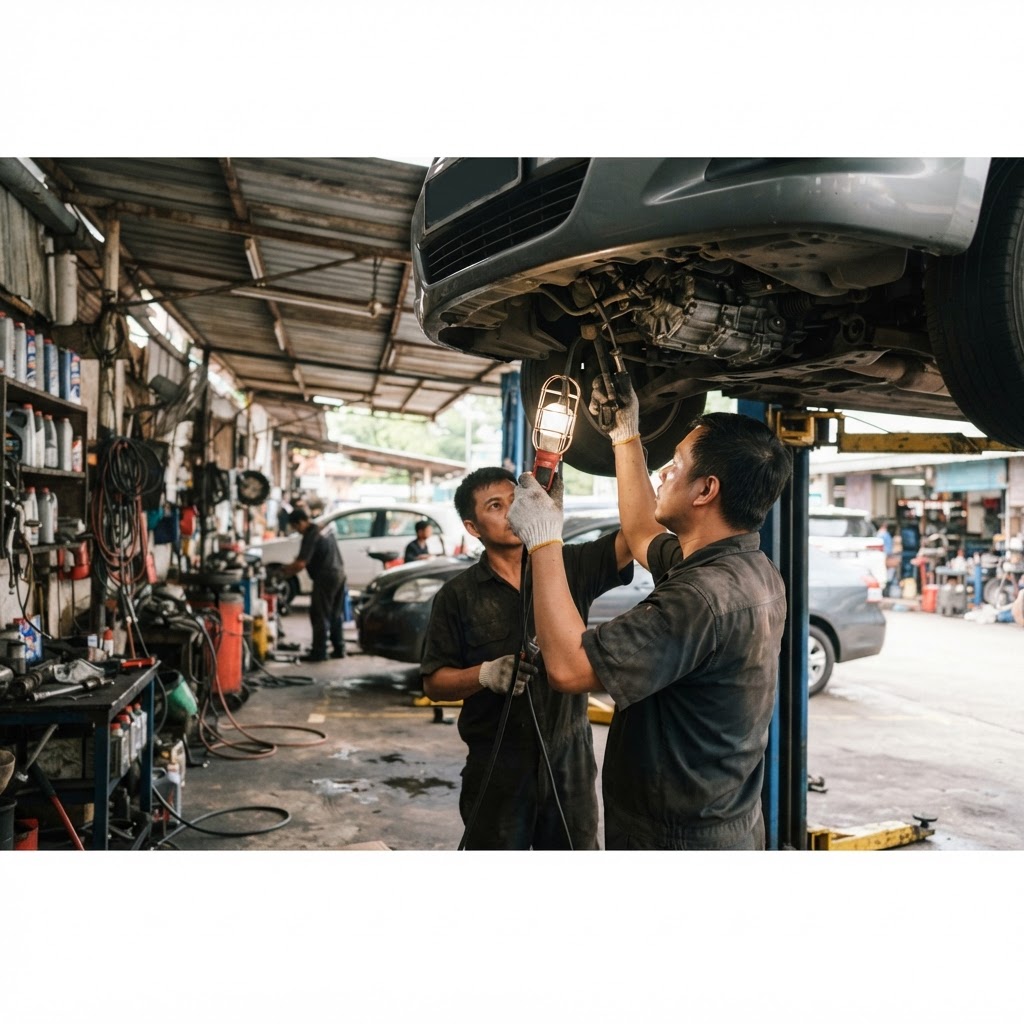
Common signs of a transmission problem
Transmission faults usually show up in how the car drives. Watch for these:
- Slipping: engine revs rise but the car does not speed up the way it should.
- Delayed engagement: a pause or jerk after you shift from P to D or R.
- Harsh or jerky shifts: a bump or thud when the gear changes.
- Shuddering: a vibration when pulling away or at certain speeds.
- Noise: whining, humming or clunking that changes with speed or gear.
- Burning smell: may point to overheated transmission fluid.
- Warning light: a transmission or check engine light on the dashboard.
One sign on its own does not prove the gearbox is faulty. Several signs together, or signs that keep getting worse, are more worrying.
Step 1: Note exactly when it happens
Write down when the problem appears. Good notes save diagnosis time.
- Only when the engine is cold, or only when it is hot?
- In which gear or at what speed?
- When accelerating, braking or pulling away from a stop?
- Does it happen every time, or only now and then?
Also note whether the car is an auto, CVT, dual-clutch or hybrid. They behave differently, and a feel that is normal in one type can be a fault in another. Your owner's manual will tell you which type you have.
Step 2: Look for leaks under the car
Park on a clean, level spot and check the ground after the car has stood for a while. Automatic transmission fluid is often reddish or brownish, but the colour varies by car and fluid type. Engine oil, coolant and aircon water can also drip, so do not guess.
Clear water is often just aircon condensation, and it commonly drips near the front of the car, though the spot varies by model. Our guide on water under the car explains how to tell the difference.
Step 3: Check the transmission fluid, if your car allows it
Some cars have a transmission dipstick. Many newer cars have sealed transmissions with no dipstick, and these should be checked by a workshop with the right tools. Do not force it open.
If your car has a dipstick, follow your owner's manual for the correct procedure. Engine on or off, gear position and temperature differ between models. When reading the fluid, look at:
- Level: low fluid can cause slipping and harsh shifts.
- Colour: very dark fluid is a warning sign.
- Smell: a burnt smell is a warning sign.
- Contents: metal flecks or sludge mean you should stop and get it checked.
Do not top up with a random fluid. Transmissions are fussy, and the wrong type can cause damage. Check the manual or ask a workshop which fluid your car needs.
Step 4: Check the dashboard and scan for codes
A transmission or check engine light means the car has stored a fault. A workshop with the right scan tool can read the codes. A code points to the area of the fault, but it does not always name the exact part, so further testing is usually needed.
Do not clear the codes yourself before a workshop sees them. They help the mechanic find the cause.
Step 5: Rule out look-alike problems
Not every gear-related symptom comes from the transmission. Some causes are cheaper and easier to fix:
- Engine misfire or weak battery: can feel like jerking or hesitation.
- Worn engine or transmission mounts: can cause clunks when shifting.
- Wheel, tyre or driveshaft issues: can cause vibration at speed.
- Low engine oil or coolant: can cause overheating and a burning smell. Read car burning smell for other possible causes.
This is why a proper inspection and test drive matter. Replacing a gearbox because of a symptom that came from something else is an expensive mistake.
When to stop driving
Stop driving and get the car checked soon if you notice:
- Strong burning smell with slipping or no drive.
- The car will not move in any gear.
- Loud grinding or banging noises.
- Fluid actively leaking.
- A warning light together with rough shifting.
Continuing to drive can turn a smaller repair into a bigger one. If the car will not move safely, arrange towing rather than forcing it.
What to tell the workshop
Send a short message with these details. It helps the workshop judge the problem before you arrive:
- Car make, model and year.
- Auto, CVT, dual-clutch or hybrid, if you know.
- What you feel or hear, and when it happens.
- Any warning lights or leaks.
- Recent servicing or repairs.
- Photos or a short video of the dashboard, leak or noise, if safe to take.
Costs depend on the car and the cause. For general reference, see our starting prices page. For general servicing and repair, see car servicing and repair, and ask us on WhatsApp whether we can check your car's transmission problem.
FAQs
Can I diagnose transmission problems myself?
You can spot symptoms, check for leaks and read the fluid if your car has a dipstick. You cannot reliably find the exact fault without scanning and testing. Use your findings to describe the problem to a workshop.
Is a transmission problem always expensive?
No. Some issues are simple, such as low fluid, a leak, a sensor, or a worn mount. Others are bigger. The cost depends on the cause, which is why a proper diagnosis comes first.
Can I keep driving with a slipping transmission?
It is risky. Slipping can get worse and cause further damage. If it happens often or comes with a burning smell, get the car checked before driving it more.
Does a check engine light mean the transmission is faulty?
Not necessarily. The light covers many faults, including engine and sensor issues. A scan helps show which area is affected.
Do all cars have a transmission dipstick?
No. Many newer cars have sealed transmissions with no dipstick. Check your owner's manual or ask a workshop.
Edwin Garage Aircon & Car Repair is at Blk 5032 Ang Mo Kio Industrial Park 2 #01-295, open Mon-Sat 10am to 8pm and closed on Sundays. If your car is shifting badly, WhatsApp us and tell us what you notice.