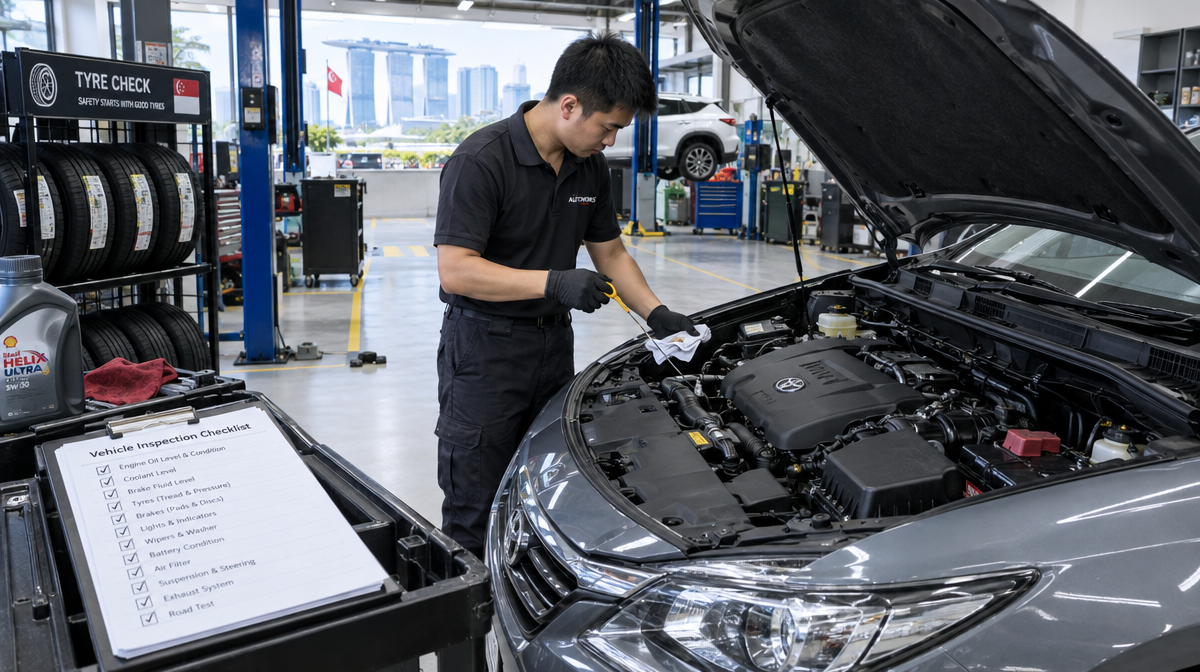
A car service should make ownership simpler, not more confusing. Whether you drive daily, use your vehicle mainly at weekends, or are preparing for an inspection, a clear servicing checklist helps you understand what is being checked, why it matters and what to keep for your records.
This guide explains the practical items Singapore drivers can discuss with a workshop. It is not a substitute for the maintenance schedule in your vehicle handbook: the manufacturer’s requirements and the vehicle’s actual condition should always lead the decision.
A sensible routine service normally starts with an inspection and a review of the vehicle’s mileage, age, recent repairs and any concerns from the driver. Common areas include engine oil and filter condition, fluid levels, brakes, tyres, battery health, lights, belts, hoses and warning messages. The exact work depends on the service interval and the make and model.
For a transparent visit, ask the workshop to separate work into three groups: maintenance due now, safety-related concerns requiring prompt attention, and items that can be monitored. That simple distinction makes an estimate much easier to understand.
Before you book: prepare the useful details
A few notes before the appointment can make diagnosis faster and prevent vague descriptions from becoming vague repairs. Have the following ready:
- Current mileage and the date or mileage of the last service.
- Your service booklet, digital maintenance record or previous invoices.
- Any dashboard warning light, including when it appeared and whether it stays on.
- Noises, vibrations, odours, leaks or changes in braking, steering or air-conditioning.
- Whether the issue happens only at cold start, in traffic, at speed or during rain.
Specific observations are valuable. “A squeal during the first few minutes after starting” is more useful than “the car sounds strange.” If a warning light is red, braking feels unsafe, the engine is overheating or there is a strong fuel smell, avoid treating it as a routine-service item; seek advice promptly.
Essential car servicing checks to discuss
Engine oil and oil filter
Engine oil reduces friction and carries heat away from moving parts. The correct oil specification, rather than only the brand or viscosity printed on a promotion, matters for modern engines. Ask which specification is appropriate for your car and whether the change is based on the handbook interval, mileage, time or operating conditions. The oil filter is usually considered alongside an oil change because it captures contaminants from the lubrication system.
Fluids, filters and cooling system
Technicians may check brake fluid, coolant, transmission fluid where applicable, washer fluid and power-steering fluid on older hydraulic systems. Each fluid has a different purpose and service requirement. Rather than approving every replacement automatically, ask what test, interval or observation supports the recommendation.
Air, cabin and fuel filters may also be inspected. A restricted engine air filter can affect airflow, while a cabin filter relates to air entering the passenger compartment. Replacement need varies with use and environment, so a visual check or stated interval provides a clearer basis than guesswork.
Brakes, tyres and wheels
A brake check can cover pad thickness, disc condition, flexible hoses, leaks and brake-fluid condition. Tell the workshop about any pulling, vibration, squealing, a soft pedal or reduced stopping confidence. These symptoms deserve assessment, but they do not automatically identify one failed part.
For tyres, ask for the measured tread depth and an explanation of any uneven wear. Uneven patterns can point to tyre pressure, wheel alignment, suspension or driving-condition factors. Check the spare tyre or tyre-repair kit too, if your vehicle has one. Tyre pressures should follow the vehicle manufacturer’s recommended setting, typically shown on a label or in the handbook.
Battery, lights and electrical basics
Battery problems can appear as slow cranking, repeated warning messages or electrical features behaving inconsistently. A battery health test and charging-system check give more useful information than relying on age alone. Ensure exterior lights, brake lights, indicators, wipers and washers are also tested; these small items affect visibility and communication with other road users.
Questions that encourage an honest, efficient service
Good questions are not confrontational. They help both sides agree on the scope of work before it begins. Consider asking:
- What is due according to my vehicle’s maintenance schedule
- Which recommendations are urgent, and what risk is involved if I wait
- Can you show me the measurement, diagnostic result or worn part
- What parts and fluids will be used, including the specification
- Will you contact me for approval before any additional work
- What is included in the quoted labour and what could change the final total
Ask for an itemised estimate where possible. It should distinguish parts, fluids, labour and any diagnostic charge. If the workshop finds unexpected work, a clear call or message with the reason and revised cost lets you decide with the relevant information in hand.
What to keep after the service
Keep the invoice, service checklist, diagnostic report where provided and any warranty information for installed parts. Record the date, mileage, oil or fluid specification and the next recommended service point. These records make future fault-finding easier and help a subsequent workshop understand what has already been done.
If old parts are available, you can ask to see them. This can be helpful for understanding a recommendation, although some parts may need to be retained for inspection, exchange or disposal procedures. The key outcome is a record you can revisit—not simply a verbal assurance.
How to choose the right service level
“Basic,” “major” and “full” service packages are not universal technical terms. Compare the actual checklist rather than the package name. A lower-cost service may be right if it aligns with the handbook interval and your car’s condition; a more extensive visit may be appropriate when a time-based item is due, a fault is being investigated or mileage calls for additional checks.
Do not delay diagnosis when there are safety concerns or clear changes in how the vehicle drives. Conversely, routine maintenance should be planned around evidence, manufacturer guidance and an explained recommendation rather than pressure.
Frequently asked questions
How often should I service my car in Singapore
Follow the service interval in your vehicle handbook, which is commonly stated by time and mileage. Heavy use, repeated short trips or unusual symptoms may justify an earlier assessment.
Should I approve extra work found during a service
Ask why it is needed now, what evidence supports it, the estimated cost and the consequences of waiting. Safety-related faults may need prompt attention; other items may be suitable for monitoring.
Is a checklist more important than a service package name
Yes. The name of a package can vary between workshops. The detailed tasks, correct parts and fluids, and documented findings provide the meaningful comparison.
What should I do if a warning light comes on after servicing
Contact the workshop promptly and describe the light and vehicle behaviour. For urgent warnings, overheating, loss of braking confidence or a strong fuel smell, stop driving if it is unsafe and seek appropriate assistance.
A well-run service leaves you with a vehicle that has been checked thoughtfully, a clear account of what was done and a practical next step. That is the standard worth looking for.
Key Takeaways
- Before you book: prepare the useful details
- Essential car servicing checks to discuss
- Questions that encourage an honest, efficient service
- What to keep after the service
Got a Question? Ask Edwin
Edwin Garage is in Ang Mo Kio. We serve Hougang, Yio Chu Kang, Serangoon & surrounding areas.
WhatsApp Edwin Book Appointment